Monday, June 19, 2023

The Whydah Gally Tutorial Pt 1

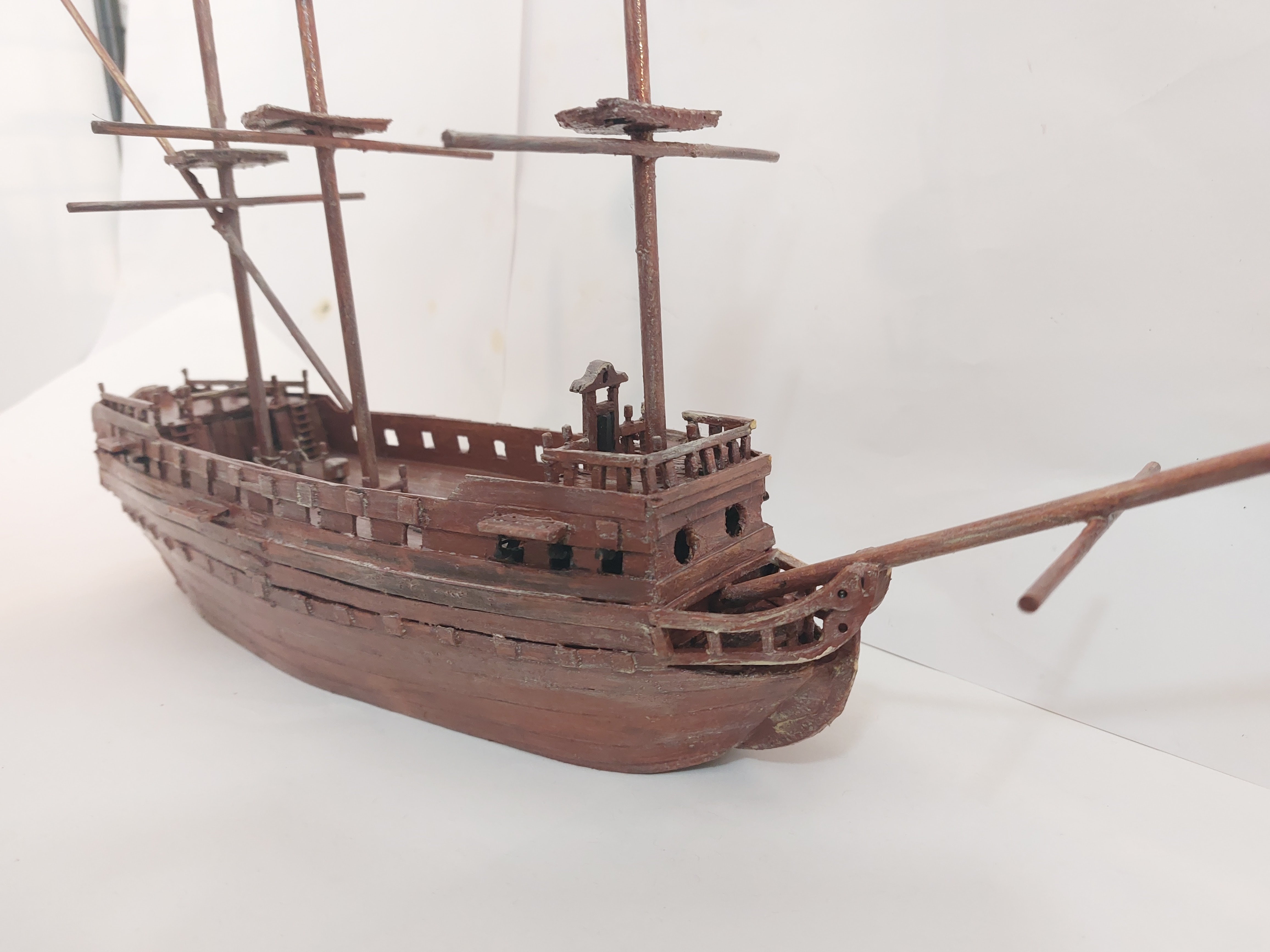
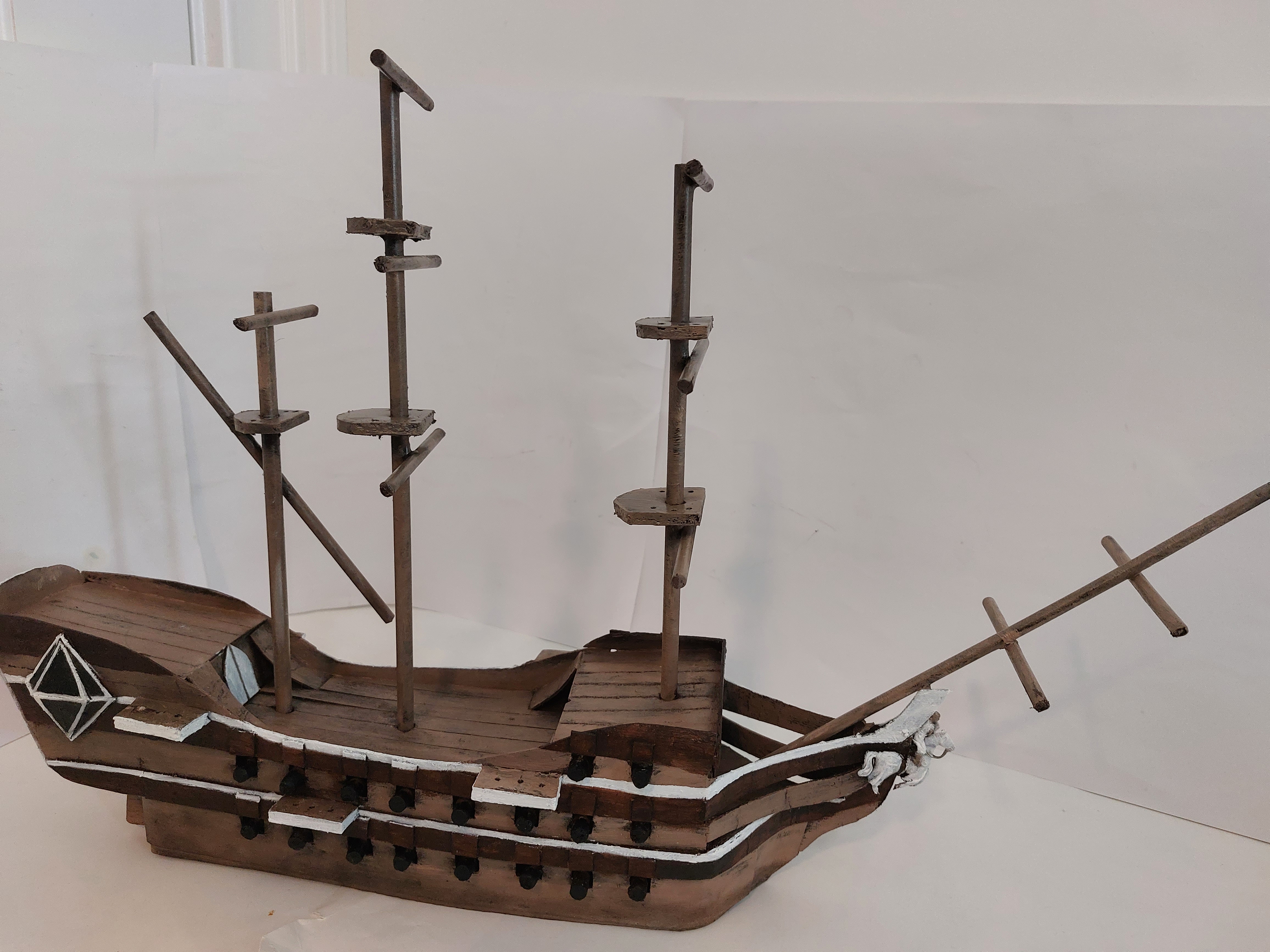
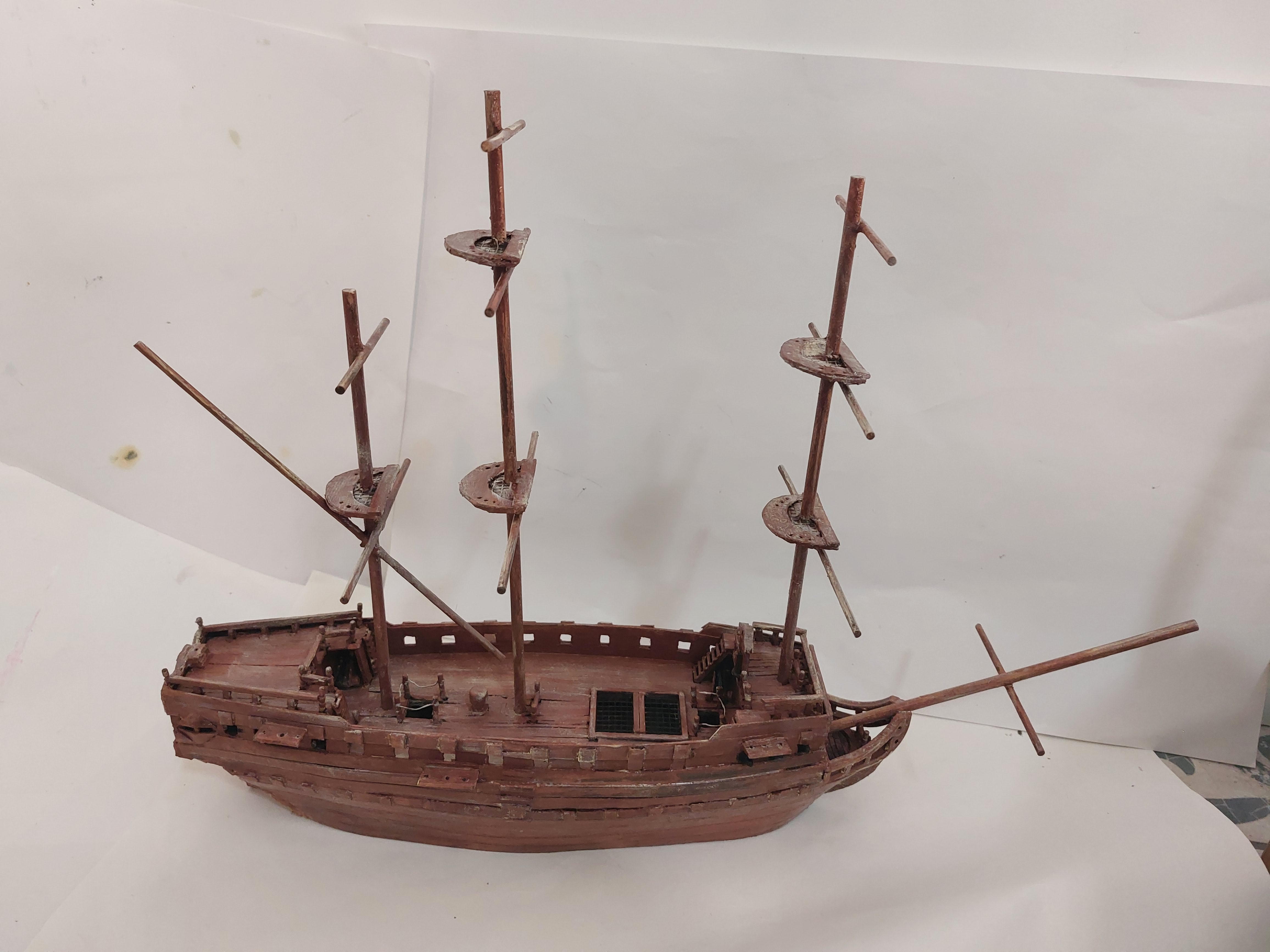
Today is Juneteenth, a holiday commemorating African-American emancipation from slavery in the US.  I thought it would be fitting to give a sneak peak of my model of the Whydah Galley. The Whydah was a slave ship captured by the pirate Black Sam Bellamy in March of 1717 after a three day, three hundred mile chase through the seas between Cuba and Hispanola. While the Whydah's captain had already sold most of the African captives into slavery, when the pirates arrived there were still fifty slaves onboard (according to some sources). Every one of those African captives, when offered the choice, joined up with Bellamy's crew, which according the they Whydah Pirate Museum was among the most diverse and most democratic of pirate crews.


I've spent the last few weeks diligently working on this model of the Whydah. I hope to have it ready for my art show at the local branch of the library, which will be up for the month of July. I followed the same procedure I used in previous models, though I based it on paintings, engravings, and other models purporting to be of the Whydah, took my time and added a lot more details than I have before. 


Thats all for now, as I said, a quick sneak peak. Next  I'll paint the details, add the rigging and sail. Later, I'll share those updates as well as a full tutorial of how I build this.

Check out the Tutorial Pt 2 to see how I finished this model.

                Down with Slavery, and Up with Freedom!!!

Previous posts which mention the Whydah and Sam Bellamy.

Why Pirates of the Golden Age?

Scratchbuilding the sloop Marianne and the Sultana Galley (Tutorial)


Saturday, June 3, 2023

Assault Guards and Civil Guards

This week, I took some photos of two of my Spanish Civil War security forces: Guardia de Asalto (Assault Guards) and Guardia Civil (Civil Guards). During the Spanish Civil War, Assault Guards and Civil Guards fought on both sides of the conflict. As the war went on, each side reorganized their security forces, sometimes updating the uniforms. I've painted my security forces in the pre-war uniforms which would have been worn in the first months of the war.

The first set of photos is of the Assault Guards. Before the war, this unit operated in urban areas, often repressing workers movements. It must have been strange for both the officers and the radical syndicalists to find themselves on the same side of the barricades in the summer of 1936.


These assault guards are from a variety of plastic sets. Some are from Barcelona Universal Models, but most are converted from WWI sets.


This MG teams was originally from the HAT Industrie Russian WWI heavy weapons set. Most of the riflemen around the MG crew are from BUM...


Such as this second MG, which were originally SCW soldiers before I gave them new heads.


I have a few Assault Guards on horseback, from BUM.


 I also made a group of seated Assault Guards out of WWI Russian artillery riders. They are seated on a removable platform, so they can be swapped out of the truck for various other factions, as the scenarios require.


The Assault Guard's command piece is from a plastic WWI set.


As are the most of artillery crew and the mortar team.


While most of the Assault Guards are converted pieces from WWI sets, it is not so easy to convert plastic sets into Civil Guards, due to their unique hats.

Civil Guards were the rural police of the Spanish government. Like the Asaltos, they found themselves on both sides of the war.


Almost all of my Civil Guards are from BUM sets, such as these riflemen by the pig pen. A lot of these are flimsy resin pieces, which often suffer broken gun barrels. 


These grenaders are of the same flimsy BUM resin. The SMG-carrying officers they are standing with, however, are nice metal pieces from Irregular Miniatures.


This group is of the same mix.


It was a happy coincidence that I arranged my security forces on either side of this farmers' pig pen.

Wednesday, May 31, 2023

Woodes Rogers' Ship Delicia

Captain Woodes Rogers, (yes, Woodes was his first name!) was from a wealthy shipping family from Bristol, England. He was a seaman from an early age, a slave trader, and a privateer against the Spanish who circumnavigated the earth while retaining both of his ships, the Duke and the Duchess, but losing his brother. Returning to England, Rogers lost a lawsuit brought by his crew over nonpayment of wages that drove him into bankruptcy, but in publishing his account, A Cruising Voyage Around the World, was able to regain some of his wealth and prestige. 

Along the trip, Rogers had rescued a marooned man named Alexander Selkirk, a Scottish sailor of the Royal Navy, from Juan Fernández Island in 1709. Selkirk, who survived alone for four years, served as Daniel Defoe's inspiration for his famous character Robinson Crusoe. 

In 1713, Woodes Rogers set of on a slaving expedition to Madagascar, though his real motive was to locate the legendary pirate colonies on the island and force them to surrender. For this voyage, Rogers, with the help of his financiers, purchased the Delicia, a 460 ton merchant vessel outfitted for war with 36-guns. 

Rogers located the pirate colonies, and you can read a great account of his efforts to convince them to return to England and give up their way of life in Colin Woodard's book, The Republic of Pirates: Being the True and Surprising Story of the Caribbean Pirates and the Man who Brought them Down. Eventually, Rogers convinced some of them to sign a petition asking the queen for clemency, and he returned to England in 1715, where he reaped in the profits of his slave trading. 

The British East India Company rejected Rogers' proposal of returning to Madagascar to turn the pirate haven into a British Colony. Instead, Rogers refit his plan to target the pirate den of Nassau in the Bahamas.

Rogers was able the convince King George I to issue "The King's Pardon" in September of 1717, which stated that any and all pirates who surrendered unconditionally before September 1718 would be welcomed back into the British realm, with their past crimes forgiven. 

Woodes Rogers assembled a fleet of seven ships, three of the Royal Navy, with 100 soldiers and 130 colonists. His flagship was the Delicia. With stacks of pardons in hand, as well as religious pamphlets to reform the pirates into colonists, Woods Rogers set sail for Nassau in April of 1718.

The British fleet arrived in Nassau on July 24, blocking the harbor and trapping a number of pirate vessels inside. A scant few resisted, such as Charles Vane, who busted through the blockade behind a fire ship. Most of the other residents--around two hundred pirates and as many refugees from other colonies--accepted the pardon. While the British fleet was formidable, the pieces of paper on which the pardons were written turned out to be the most powerful weapon in Rogers' arsenal, and he enacted the strategy of divide and conquer. The lack of unity among the pirates, exasperated by the existence of the pardon, ruined their ability to resist. Woodes Rogers became Royal Governor of the Bahamas until 1721, and served in that position again from 1728 until his death in 1732.

In building for a future Pirates game or campaign, I've built Woodes Rogers' ship, Delicia, as he makes the perfect opponent for my pirates.

Using roughly the same process I followed to build Bellamy's early ships, the Marianne and Sultana,  I contstructed the Delicia from cardboard and wooden dowels.


Adding the cannons to this ship was particularly difficult, as there are quite a few and I needed to balance each one as the glue dried.


Having very little to go on for this design, besides the weight of the ship and how many guns it held, I had to be creative. For the figurehead, I used a templar crusader, which seemed a fitting image for Rogers' anti-pirate expeditions.


After completing the general construction, I spray-primed the ship dark brown.


Next, I set about painting the ship in oil paints.


When the paint dries, I will add the sails and the rigging, and then the final paint touches: silver for the knight's armor on the figurehead, as well as for the name of the ship on the stern.

In the mean time, I will finally begin building the ships I set out to learn the skills to build some twenty or so vessels ago -- the Whydah Galley, in 2 versions. Wish me luck and check back later for updates!
Monday, May 29, 2023

Right-wing Militias

During the Spanish Civil War, both sides of the conflict fielded ideological militia units. Today, I am sharing my Right-Wing militias, in preparation for Scenario 3: The Battle of Caspe. Below, you will find photos of the Requete militias, followed by those of the Falange.

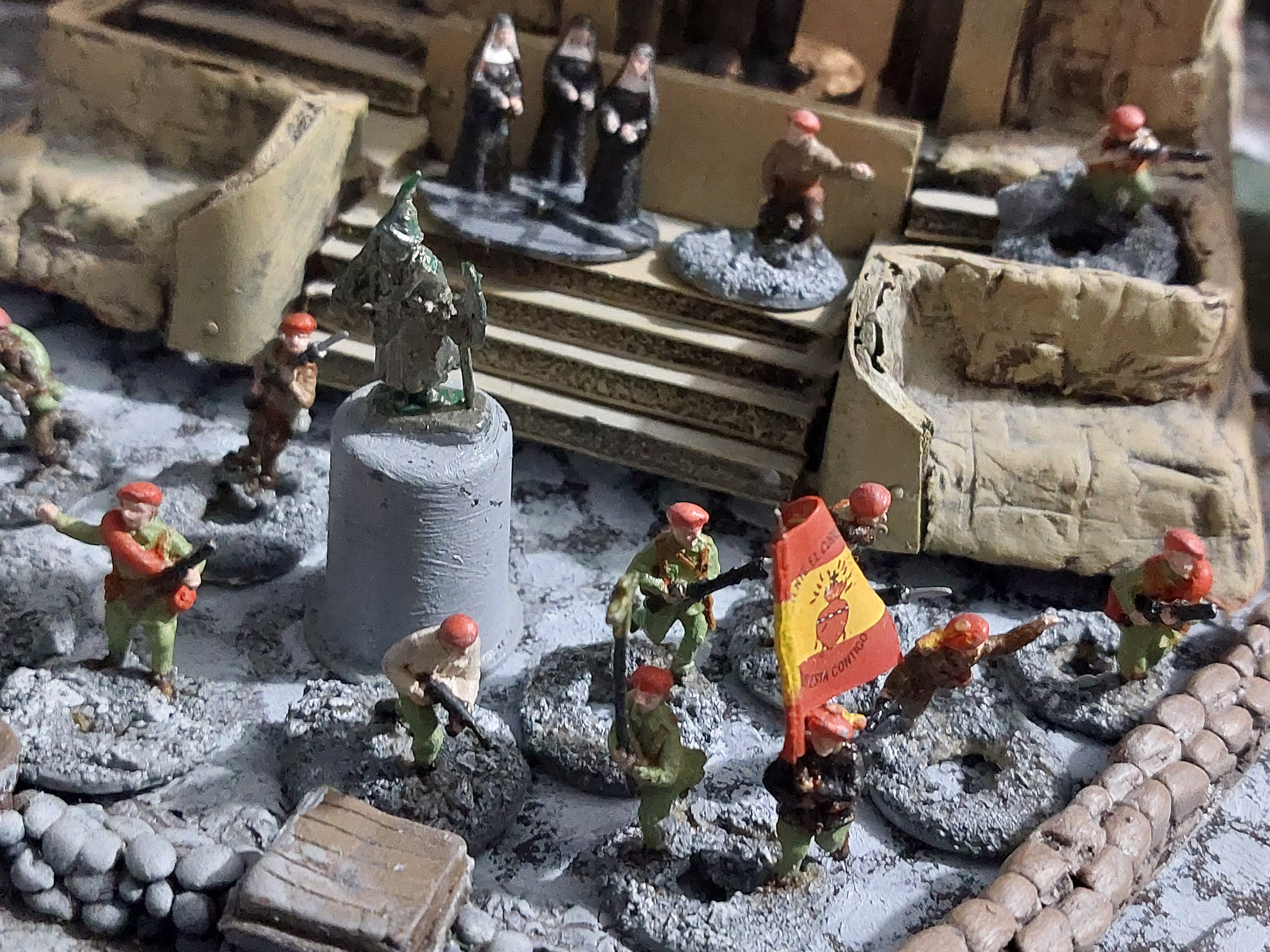
In the images below, we have the Requete militia, preparing to defend the Caspe church (based loosely off the real church in Caspe).


The Requetes began as a Catholic monarchist boy-scouts-type operation, which became militarized before the war. Politically, they were a bizarre "Carlist" faction. The movement began a century before the Spanish Civil War, by supporters of Ferdinand VII's son, Carlos V, who made a claim to the Spanish throne in 1833.

By the 1930s, they were a large and well-organized outfit, based largely in the Basque region, who wanted Spain to be even more conservative and Catholic than it already was, if you can believe that.

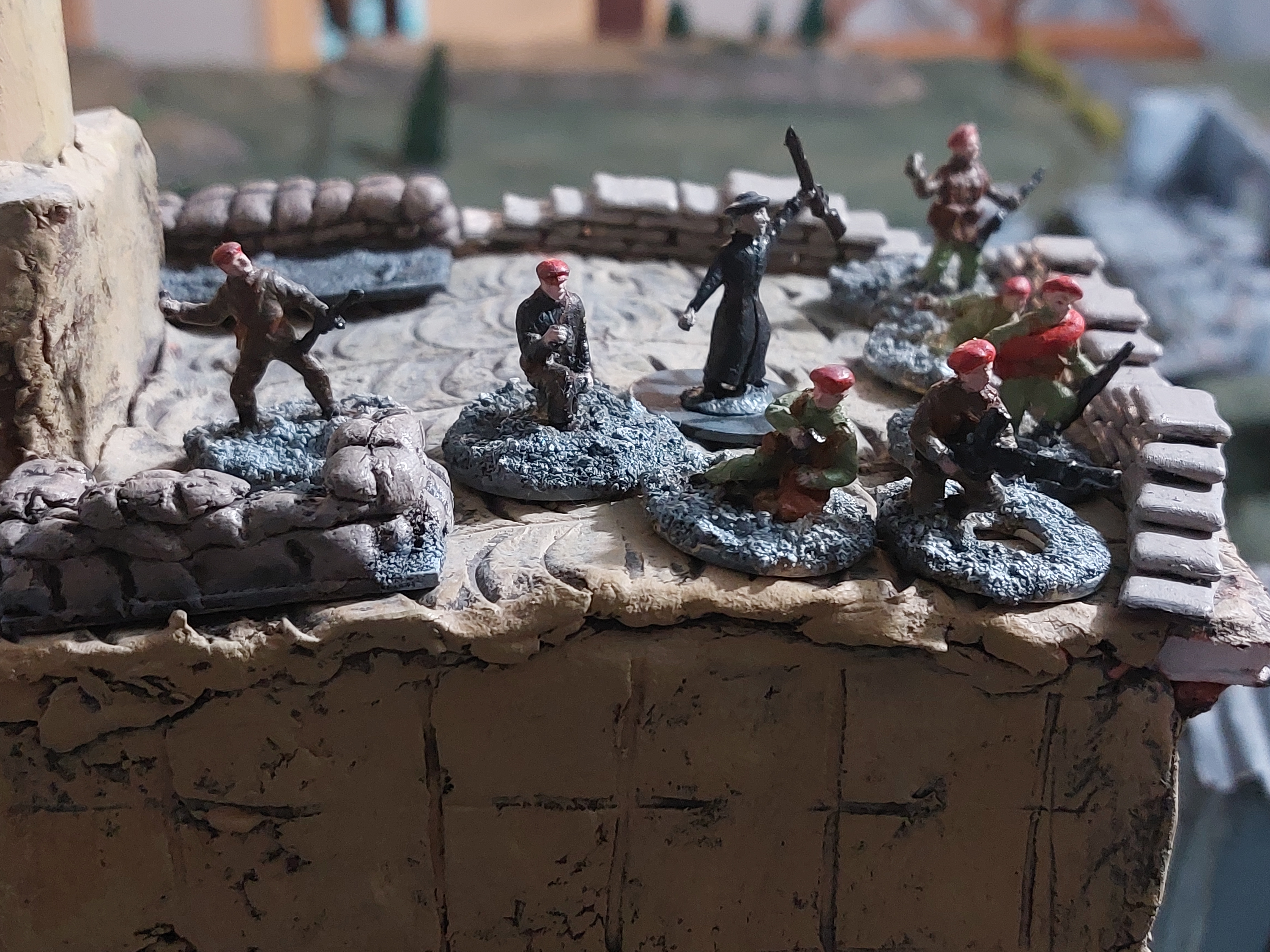
At the top of the church, various Requete militiamen stand around an armed priest (from Irregular miniatures). There are many reports of clergy members firing out at the crowds of workers in the opening days of the Spanish Civil War, which led in some cases to mobs attacking the churches. 1, 2, 3*.

With the priest are a Requete LMG team, from Miniarions, as well as various grenaders and a spotter/officer, which I believe was from one of Caesar Miniatures' partisans sets (Underground Resisters, or Partisans in Europe). 


The Carlists in the church plaza are also a mix of Minairons and Ceasars. 


In the church itself, I have another priest from Irregular, as well as nuns from the Partisans in Europe set.


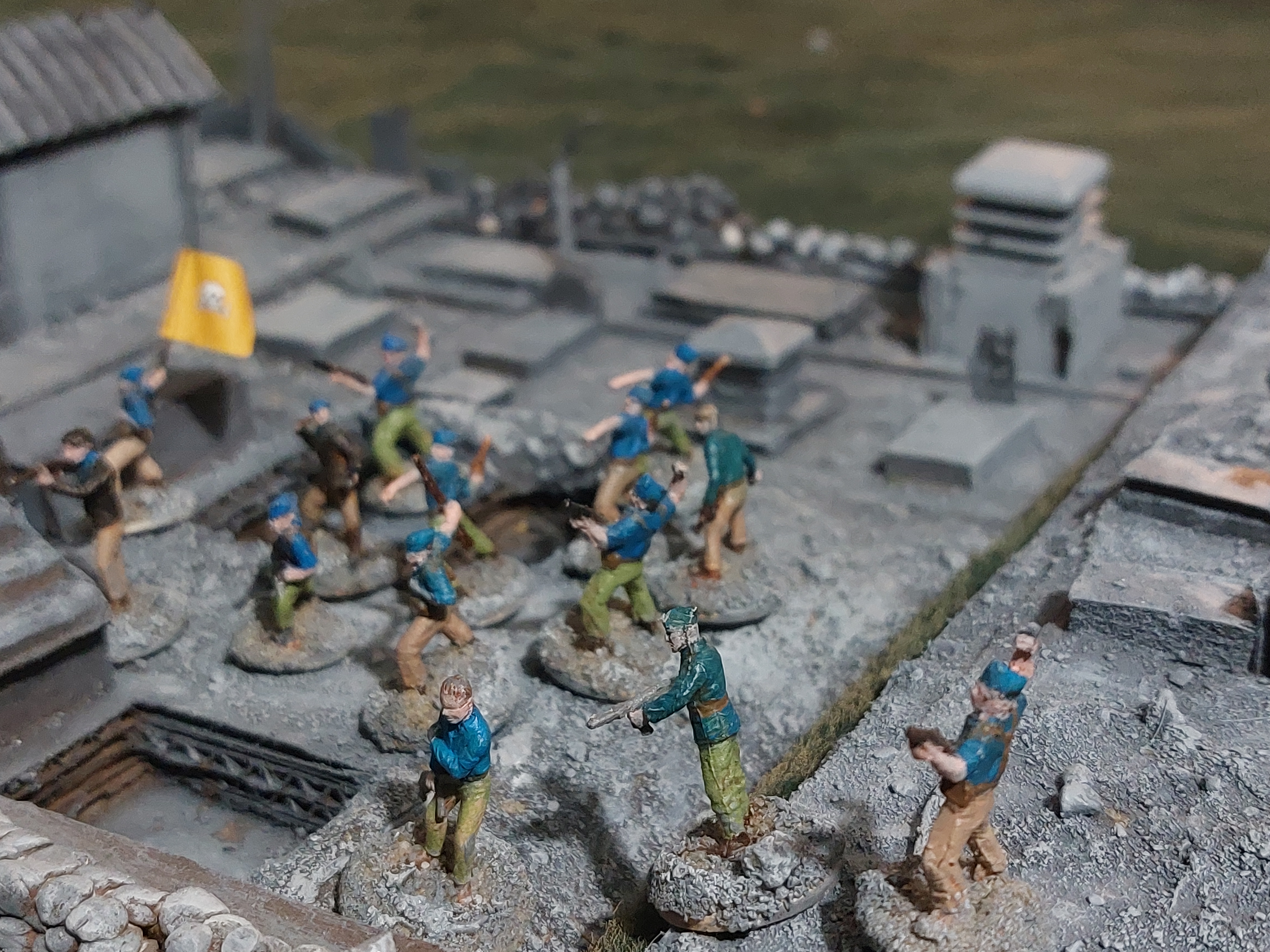
For the next set of the photos, we have the real fascists of the Spanish Civil War - The Falange militia. I won't say too much more about them politically, but I did put them here in the graveyard, where fascists belong.


These miniatures are all plastic, mostly from the same sets of Caesars' but also some Barcelona Universal Models (BUM).


*3. Paz, Abel. Durruti in the Spanish Revolution. AK, 2007. Page 435.
-Thanks to Lee for research assistance on this blog post.