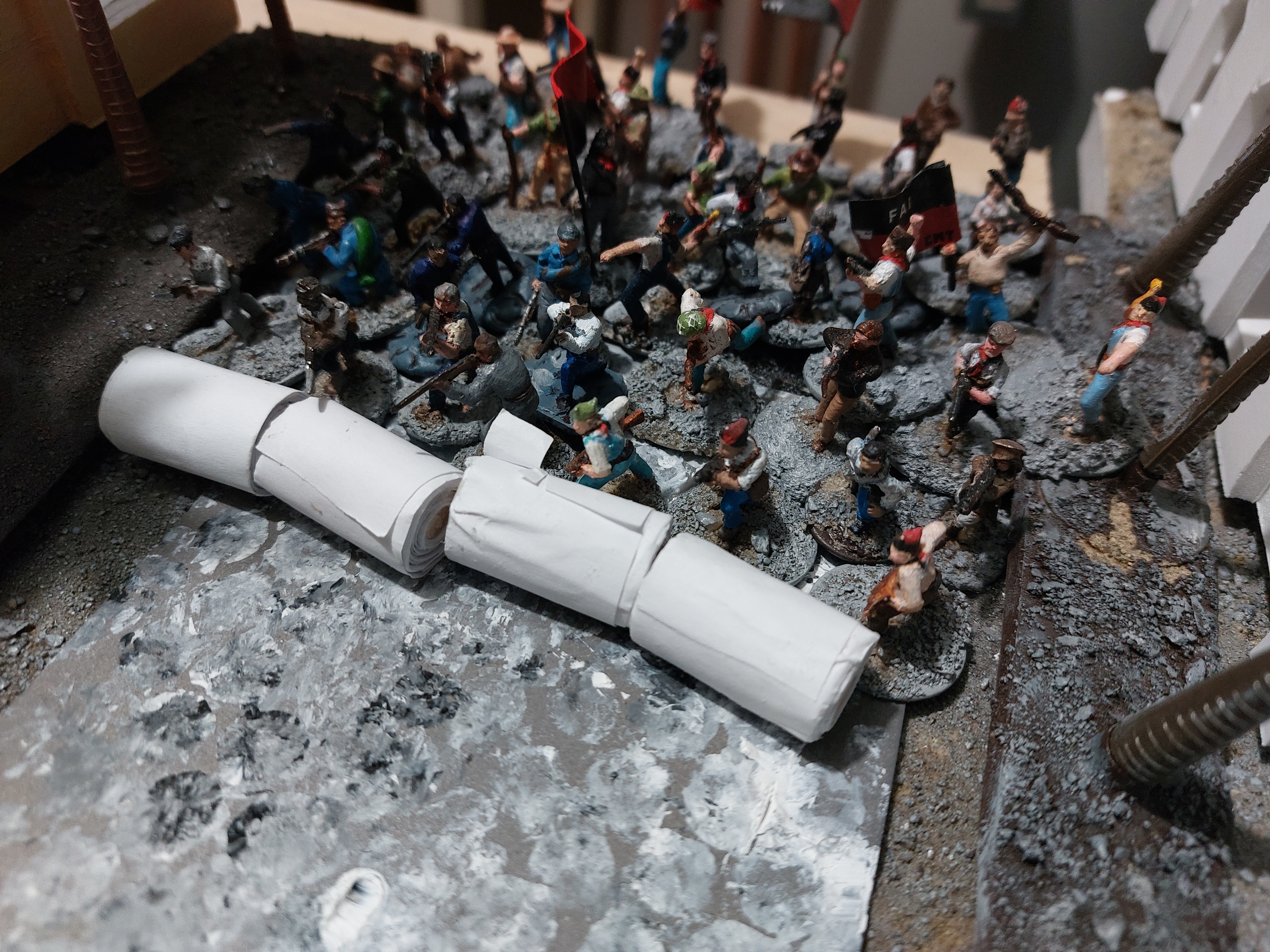
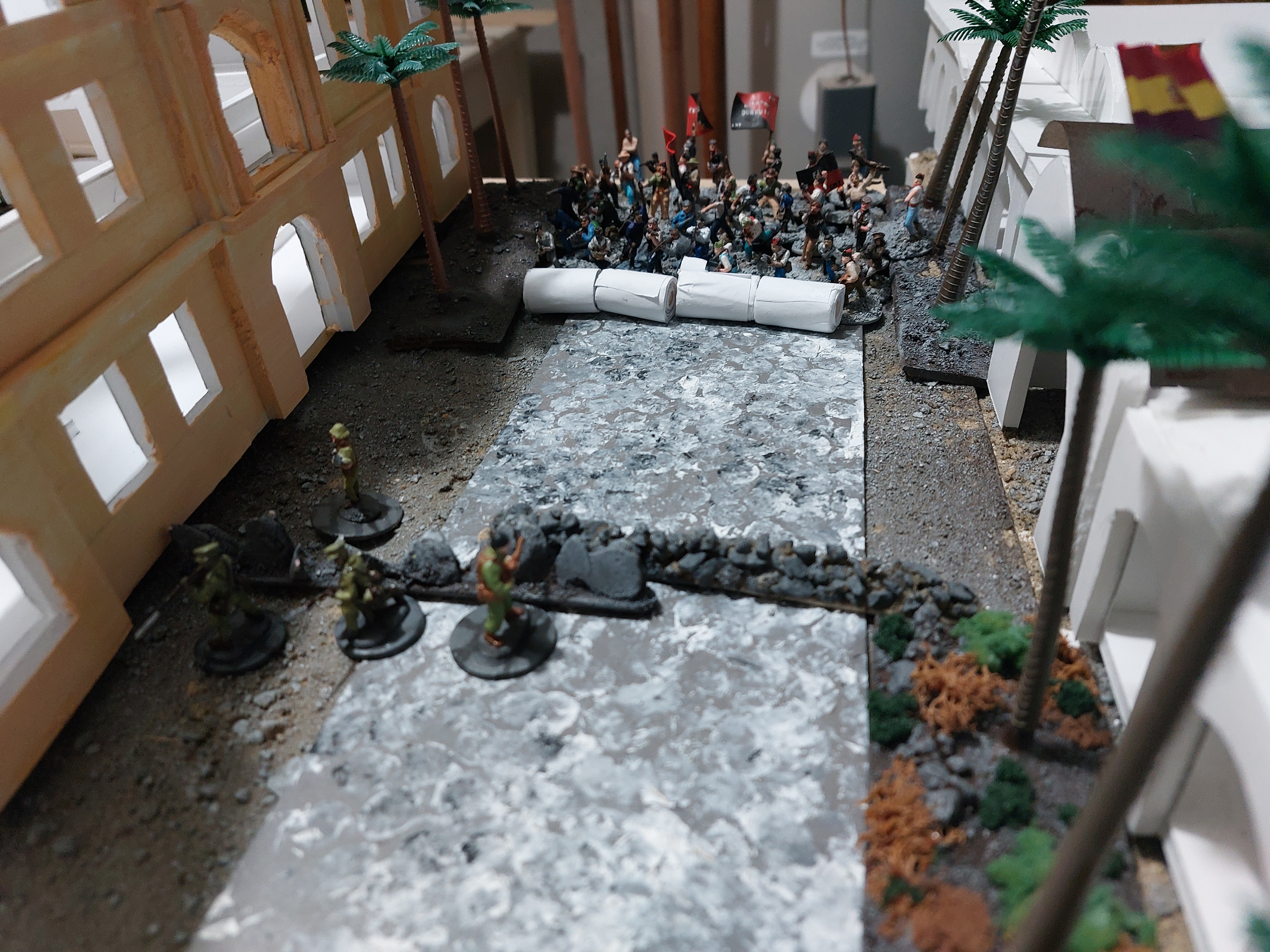
We picked up our battle of the Ronda Colom where we had left off this Sunday morning. Things looked bleak to begin with for the nationalist rebels. In previous rounds, John and I had successfully driven our anarchist workers up the table, containing the mutinous soldiers in the north-eastern corner. This is precisely where our fifty reinforcements would arrive, behind the 2 government buildings, pushing rolls of newspaper for cover (I love history, especially the history of anarchist revolts).

In the opposite corner, Lee and Chris received two trucks of infantry and another with ammunition.

John and I had built new barricades, earlier in the game, in preparation for the arrival of these soldiers. We also garrisoned the buildings on either side of the road with four riflemen each, and placed two dynamite throwers behind the stone barricades.
Chris and Lee likewise built a stone barricade to welcome our reinforcements, but as they had been forced to deal with the steady advance of the workers in the previous rounds, they were not quite ready for the arrival of reinforcing workers.
We broke out the booze a little earlier than usual, before we even started playing, actually. As a result we were perhaps not as focused or productive as usual... but we certainly entertained ourselves and celebrated May Day's eve.
Chris rolled against John for Round Initiative to kick off Round 10. Chris won. The nationalists' only remaining operational ranged weapon was a heavy machine gun outside the corner of the Dependencia Militar, center rear of the photo below. The MG crew could barely see the head of one of the anarchists behind the statue poking up behind the sandbags and pile of barrels. Chris fired the MG but could not hit the worker.
Now began our round of ranged weapons, and we sure had a bounty of options at our disposal. John kicked it off with this worker and his home-made grenade. He flung the explosive over the church wall at the blue car and machine gun in front of the Capitancia across the street.
The grenade sailed high, way high, and landed on the roof, causing 5 damage.
I fired the last shell of cannon 1, set up in front of the Theatro, and hit the roof of the Dependencia, causing minor damage. Next, John looped the plane over the courtyard of the Dependencia, and dropped a bomb perfectly below. It exploded in the courtyard, killing three generals, including the highest ranking commander of the sector, who happened to be standing in the doorway to the courtyard.
Though we did not deduct a morale penalty for the death of the top commander, I think the unexpected event damaged the morale of the players, who soon shifted to a posture of full retreat, opting to attempt the path of victory in which they win by running and surviving for 25 turns.
The cannon the workers captured at the Columbus Statue fired a shell at the orange palace by the harbor. It crashed into the building, causing 3 damage points.
One of the workers lobbed another homemade explosive at the machine gun crew in front of the Dependencia, but also tossed it to far. It destroyed one of the sand bag barricades, but caused no other damage.
Movement Phase began. Chris had the lone surviving soldier behind the blue car crawl toward the idle machine gun to break it down and haul it inside.
Lee, who took command of the reinforcements, with all parties agreeing they were in dire straits, sent their soldiers out of the trucks to fight for the barricades.
This action triggered overwatch. First, I had one of the dynamiters toss a projectile a dangerous 4 inches over the stone barricade.
The bomb fell short, landing just on the other side of the barricade and pinning the worker who threw it. The explosion killed three soldiers, however, pinned a forth, and caused 5 damage to the truck and nearby building.
The second dynamiter was even more successful.
The toss killed 5 more soldiers, pinned 4, and caused 6 damage to both trucks and the blue building.
Next, the rifles in the blue and gray buildings caught the soldiers in their crossfire, killing 4 more. Half of the platoon of soldiers was dead.
Now it was our turn for movement. Across the table, the workers charged bravely forward. Their moment had arrived.
Half of the reinforcing workers rushed into the back door of the Capitancia. With most of the soldiers inside facing out the west windows at John's advanced positions, only 4 soldiers were positioned to fire at the 25 workers entering. Chris's soldiers stood strong, killed one worker, and pinned another, but it was spitting at the rain.
The workers rushed inside, overtaking the soldiers who had already fired and splitting off to take both the east and west wings of the building. The courtyard, they left unoccupied.
Two more soldiers fired from a second floor window, across the courtyard at the anarchists in the courtyard's eastern doorway, but missed.
Workers rushed out of the I-shaped gray building in the south-east corner to join the advanced group by the statue. Soldiers fired at them from the orange palace by the water, killing two. Another 5 workers survived to join the group at the statue.
To start the skirmish phase, Chris called for a fight at the frontline between the CNT-FAI reinforcements and the soldiers at the barricade.
I won the roll, and six workers mowed down the 3 soldiers across from them. Inside the building, the workers forced two surrounded soldiers to roll for surrender. Both surrendered.
On the other side of the table, Lee's ambushed soldiers fought back. They fired at the workers who had shot at them from the windows of the buildings. This platoon had high morale due to good rolling before the game. They managed to land some pretty improbable shots, killing three workers. The soldiers now planned to withdraw and attempt the go the long way around the gray building.
Regroupment phase began. Chris initiated the general evacuation from the Capitancia. Soldiers ran for the staircase in the corner of the building.
The three soldiers alive on the ground floor made it out the low window at the south-east corner.
Next door at the Dependencia, the soldiers remained at their posts.
Across the Ramblas, workers on the second floor of the Atarazana's military office building rushed up to the roof, hunting the lone soldier remaining: a spotter who had been left behind and isolated in the pill box.
Round 11 began. Chris and Lee won the Round Initiative roll again, but when they fired their machine gun at the workers behind the Columbus statue, they missed again.
John and I began our ranged attack on the nationalist holdouts. Our plane had run out of ammunition and left the table to resupply. Also, it had fallen over and broken, again. My dynamiter on the Ramblas tossed another grenade at the machine gun nest. This one landed closer, not close enough to cause damage, but it did pin the machine gun crew and damage the building.
Behind them, the cannon at the statue fired on the orange palace, but the shell fell harmlessly short. It had not bee a very effective ranged phase for us.
The Movement Phase began. Far to the west, Lee attempted to extract the remaining soldiers from our ambush. The 5 workers who were alive in the buildings fired at the fleeing soldiers, killing 4.
Nine, however, had survived to regroup on the other side of the building.
Four soldiers and officers abandoning the Capitancia ran into the long, low white building by the harbor. They occupied the central building, to the north of the Orange Palace, where they had supplies.
Outside, the workers advanced further. A detachment of the reinfocremence with three grenaders had previously entered the northern section of the long white building by the water. Now they, and their comrades behind the newspaper rolls, prepared to charge further south. They hoped to conquer the souther section of the long white building, the ammo there, and the back door to the orange palace.
Across the Ronda, the anarchists on the roof of the Atarazanas ordered the spotter to surrender. Chris, naturally, refused.
He proceeded to win the roll to refuse surrender, then when the skirmish phase began, he won the local skirmish roll too. Then, the stubborn bastard managed to kill one of my workers with his pistol before being gunned down. Chris is the kind of guy you want on your side in a fight.
Meanwhile, the workers advanced on both sides of the palaces. John's forces marched confidently into the streets, facing no opposition.
The last soldier behind the blue car surrendered without a fight. He probably heard footsteps behind him, as our reinforcements appeared in the doorway after conquering the Capitancia.
John's advanced groups connected with our reinforcements. The all out charge on the Capitancia had been an overwhelming victory. We had only lost 3 or so comrades in the action.
Down the street to the south, more of John's attack groups raced toward the Dependencia through the ally behind the church. I brought a small group with grenaders out of the gray building I had been forced to wrest from Chris's fingers during our previous days play. They charged the machine gun nest behind the sandbags in front of the Dependencia Militar.
The gun crew there had been pinned by the earlier grenade. Thus, they could not skirmish with me, but one of the soldiers inside the vestibule of the Dependencia fired on the approaching anarchists, killing 1.
The remaining workers fired over the sandbags, obliterating the machine gun crew and one of the soldiers in the vestibule.

In the courtyard between the two long white buildings on the northern waterline, one of my dynamiters poked his head around the corner to attempt a toss on the soldiers inside.
Chris won the roll, the soldiers won the initiative and wasted my dynamiter. That's ok Chris, I have two more dynamiters coming up behind him!
During the Regroupment Phase, I advanced more workers into the Ronda. We needed to close the pockets around the surviving soldiers.
Though I knew it wasn't super smart, I reinforced the fairly-exposed group behind the Columbus Statue. Others left the Atarazanas and took cover behind the burnt out truck. I needed to amass an attack force close enough to rush the orange palace when the time came. Or at least enough workers to keep Chris's soldiers looking that way while I attacked through safer corridors to the rear...
During regroupment, my former artillery crew, armed with rifles of fallen comrades, joined the group guarding the barricade behind the Theatro. They vaulted the barricade and set off to hunt the soldiers.
My previously-pinned dynamiters peeled off the barricades, which had served us well. Three army trucks, two slightly damaged and the third full of ammo, stood, abandoned, on the other side.
Other comrades, delegates from the defense committees who had been spread out along the alleys to relay orders and information, moved west to join the chase.
On the other side of the Theatro, the truck arrived to pick up cannon 2. The crew loaded it into the bed.
We ended the day there. The workers had breached the army's defensive line and pushed on all three objectives. The original assault force, bolstered by many workers' defense groups, made contact with the reinforcing workers in the Capitancia.
The soldiers still clung to the upper floors of the Dependencia, but their hold was tenuous.
Four soldiers remained in the white building north of and connected to the orange palace, but throngs of workers pressed them from two sides.
At the end of the day, the Nationalists' strongest remaining position was the orange palace by the harbor. They had six soldiers, including a light machine gun, positioned in the windows there.
The workers of the CNT-FAI defense committees had raised the red and black flag of social anarchism over two of the three objectives.
Besides the 9 survivors of the Cavalry group on the run behind the lines, the only remaining soldiers were confined to three buildings in a wedge on the eastern edge of the table, surrounded by armed and enraged workers.
It took us a couple of days, but we have decided to call this game now and move on to the next scenario. With control of two of the three objectives in the workers hands, and the army actively abandoning the third objective, this siege has finally ended in a decisive victory for the CNT-FAI. Lee and Chris played admirably, in a scenario which all agreed was lopsided, which accurately reflected the balance of forces during the historic event.
For John and I, our battle strategy worked great. We were initially set back when Lee's first cannon shot obliterated an entire assault group of 25, but after that we were able to move steadily from building to building, holding positions outside of the northern palaces while we marched down the south side of the table, surrounding the army's positions. By the end of the four days of play, we had control of the vast majority of the table, and had captured or knocked out all of their machine guns and artillery.
Check back next time, when our campaign takes us out of the streets of Barcelona, and into the Aragon countryside, ¡Á Zaragoza!