Back in January 2022, I played a solo game with a scenario about a fictitious siege of Ensenada. The scenario presupposed that the second in command and political officer of the PLM Baja California Army, Simón Berthold, survived the mortal wound he took on the way to El Álamo, that it did not get infected and he recovered quickly.
When the PLM took El Álamo on March 27, 1911, many workers from the mining camps there and Indigenous people from the surrounding villages hurried in to join the Revolution. 100 km to the west in Ensenada, Colonel Vega was paralyzed by fright and indecision. He sent no soldiers to El Álamo, no soldiers to Mexicali, and built no defenses in Ensenada. Perhaps he felt secure in his capitol with the gunboat “Guerrero,” floating in the bay, which would have made any PLM assault on the city quite difficult. Berthold, though dying of his infected wound, began calling Vega and demanding surrender by phone. Vega dared Berthold to attack. Neither made any further moves. In the following weeks, the El Álamo detachment sent small bands of rebels to raid ranches and towns south of Ensenada.
Here is where we depart from history, imagining that Berthold recovered his health and lead the attack on Ensenada on April 4, the column bolstered by new recruits from the mining region.
Before the game begun i rollled some D6s to determine how many miners from each PLM group brought dynamite to the fight. Each group had three dynamiters.
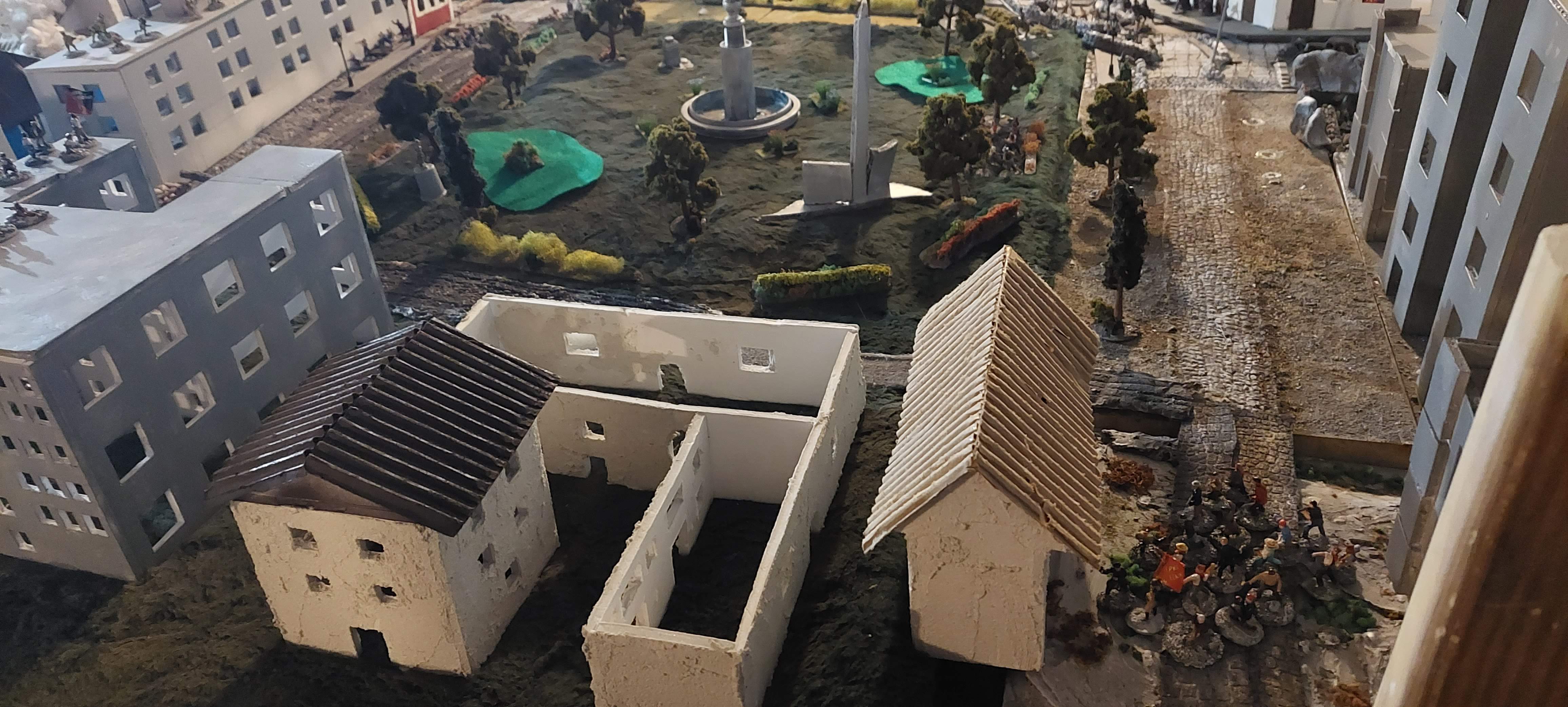
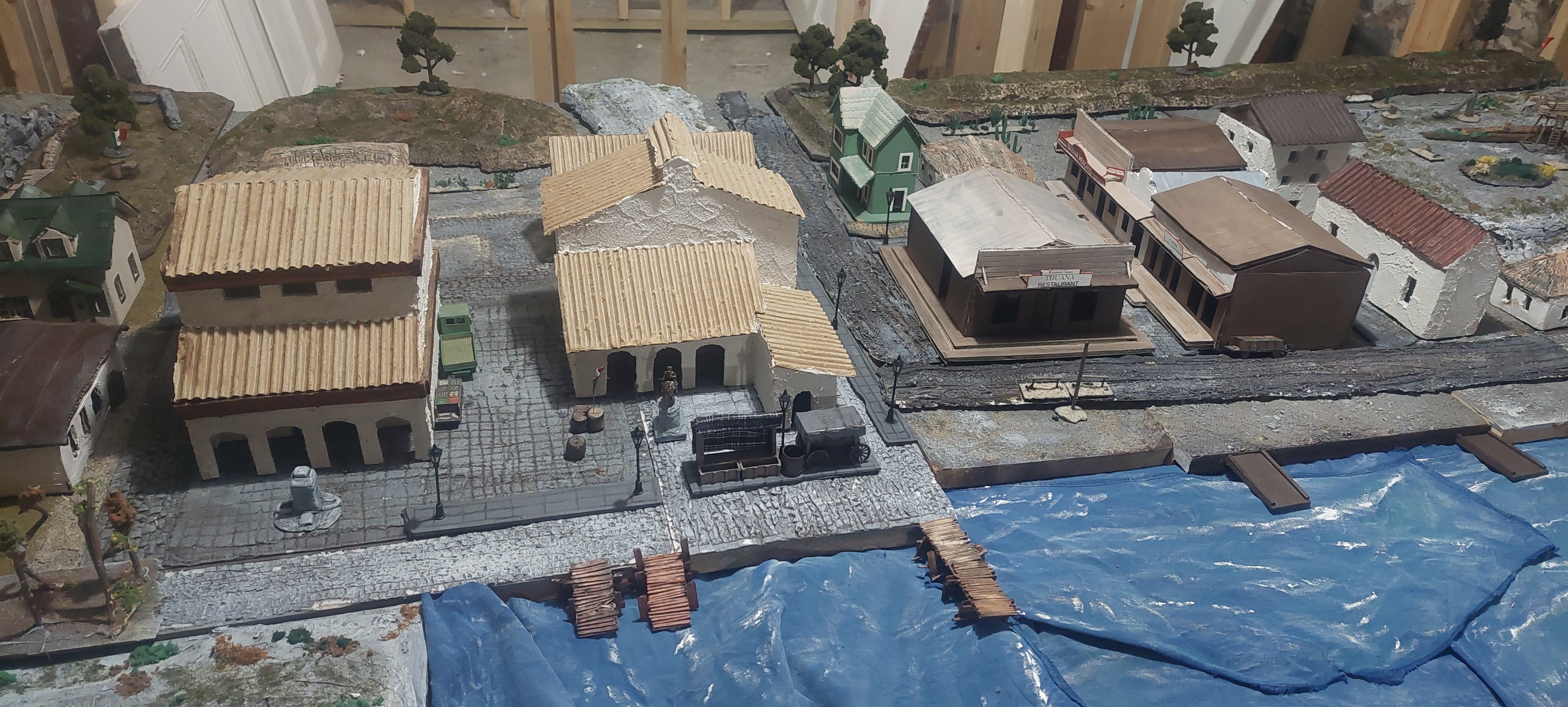
Here is the table, looking east at the town of Ensenada.

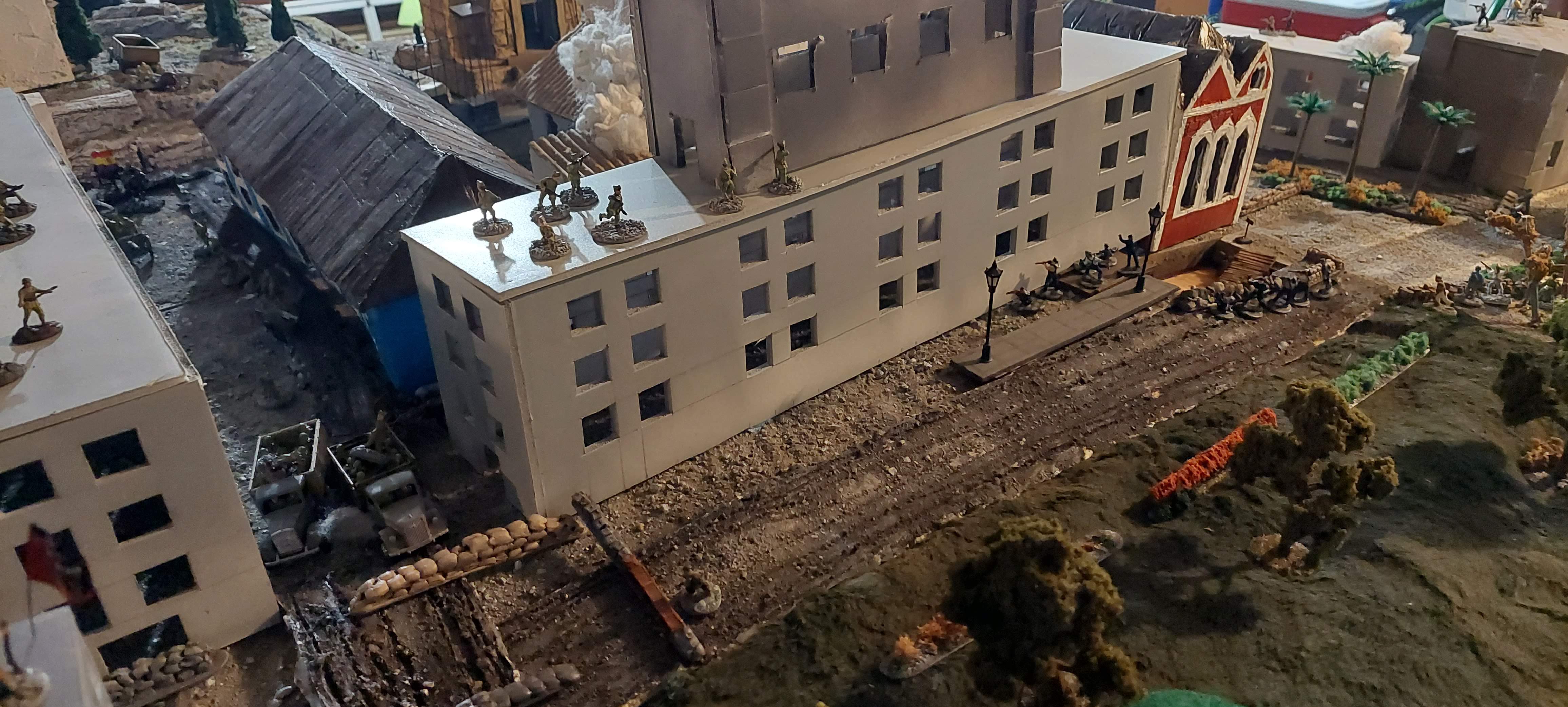
Here is the view from the north, with a fortified hill beside the entrance of the town. This was Federal position A.

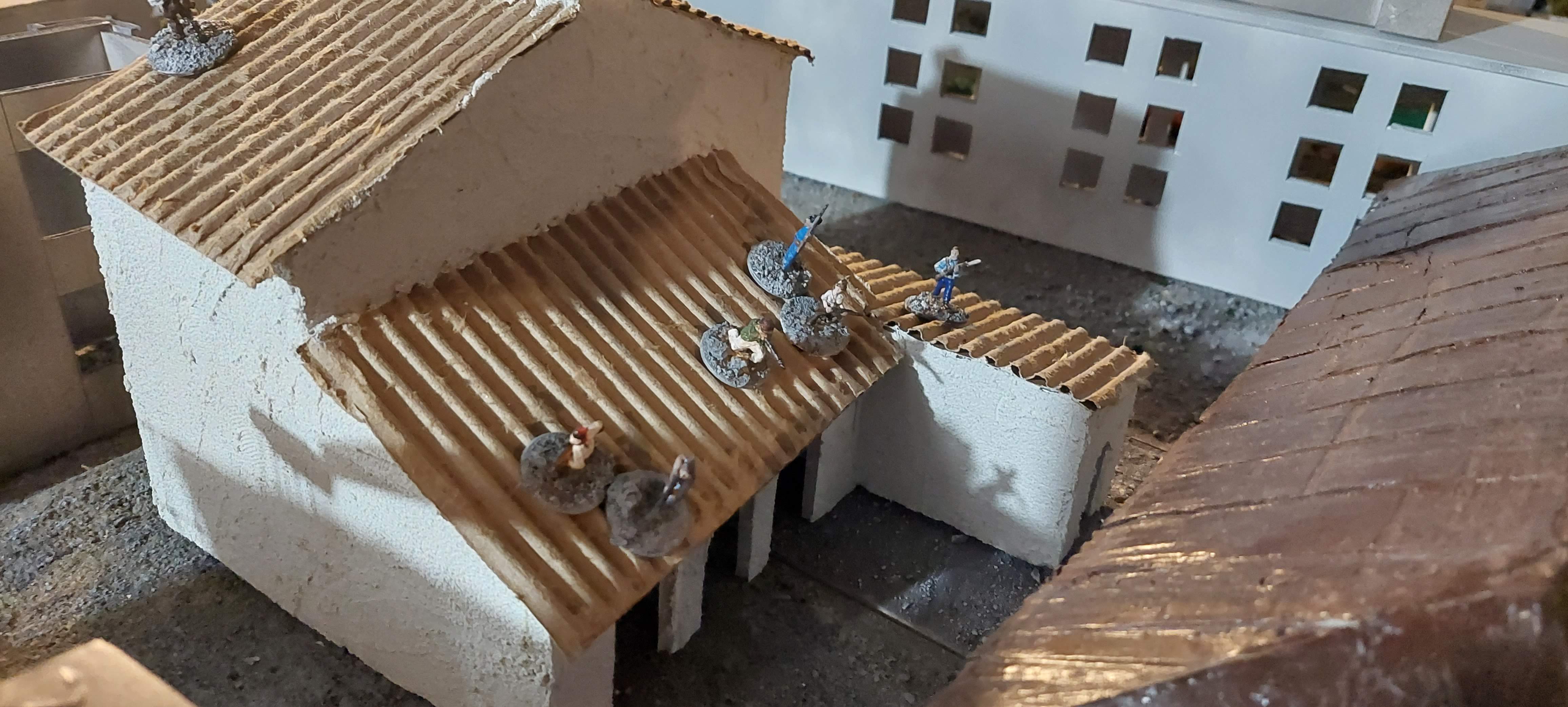
South of town stood another hill, its peak heavily fortified with sandbags and a watchtower. This was Federal Position C.

The scenario gave the PLM 255 rebels, assaulting 210 Federal soldiers, Rurales, and volunteers. I played the scenario at 1/2 that size (so a company of 50 became 25). The Federal Headquarters was set up by the government house. They were accompanied by a company of 25 Federal soldiers, which I considered the reserve company.

Another company of 25 Federal soldiers guarded the northern hill. One of their two machine-guns was installed at Position A, behind a pile of sandbags on the hill.

One company of 20 of Rurales guarded position C on the south end of town.

The second company guarded the alleys and roads north of the hill.


Finally, a group of 20 anti-Magonista militia led by five of the upperclass citizens of town on horseback, waited in reserve between the city hall and the restaurant.

Using the single-player mechanism, I rolled a D6 to determine the defenders strategy, which was scorched earth. Given their control of the off-table gunboat Guerrero, this was a fitting strategy.

The rebels arrived with a headquarters section and 5 groups of 25. Simón Berthold's mounted command group appeared in the north on turn one.

On Berthold's left was Group 4, made up of 25 IWW unionists from the US led by Captain Jack Mosby. On the right was Group 3. Off table was Group 2, commanded by Francisco Pacheco, and the PLM cavalry under Juan Emilio Guerrero.

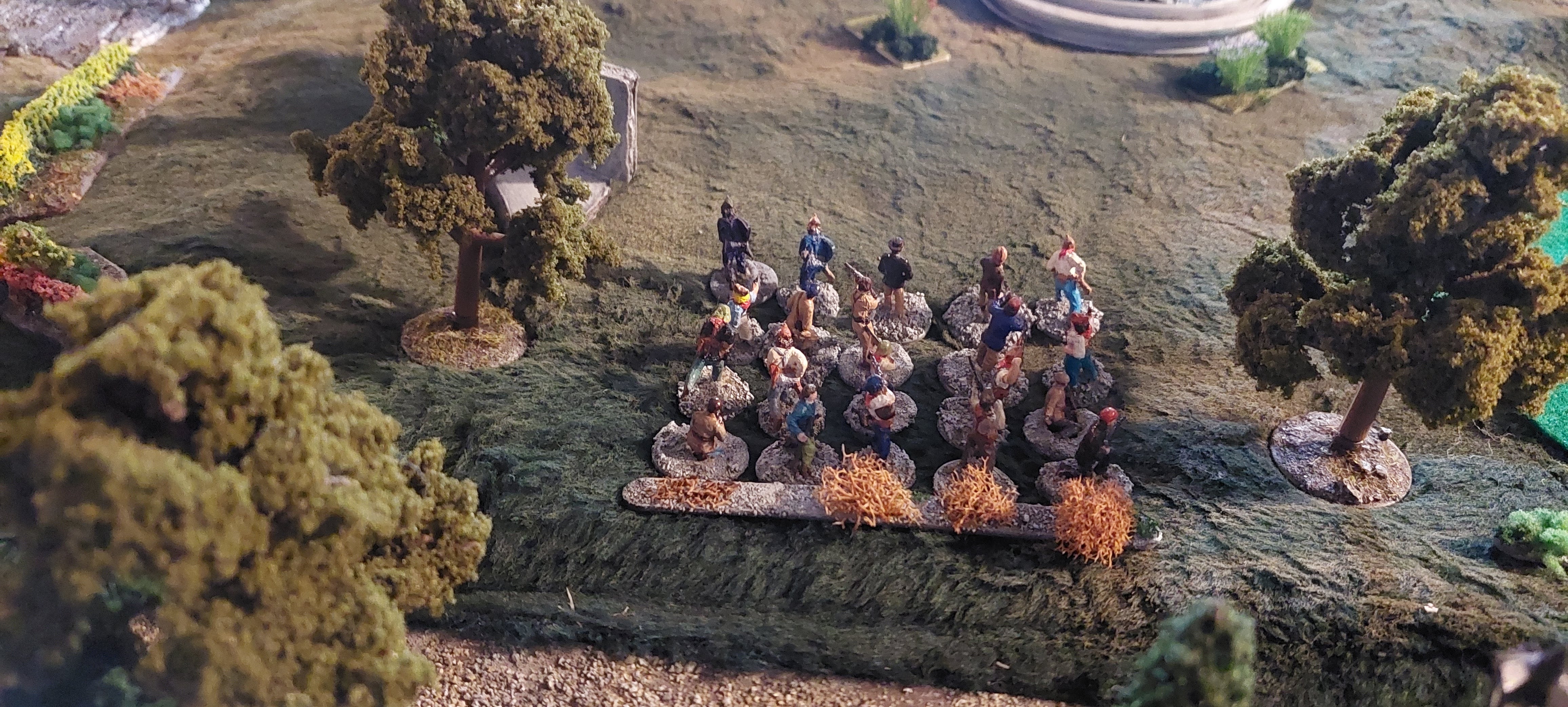
Rebel commanders made stirring speeches to prepare the insurrectos for the coming battle. In Round 1, Berthold sent three dynamiters from each group crawling up the ridge ahead toward the government outpost. The dynamiters were joined by a rifleman each.

On the south end of the table, Group 1, led by Pedro Ramirez Cauele, moved toward its intended positions in striking distance of the outpost on the hill.

They moved at a "crawl" in order to remain hidden. Some dynamite teams crossed the valley to cover the south slope of the hill.

Other sections of Group 1 stretched northward along the south-eastern ridge.

In the next few rounds, the rebels inched forward led by their dynamiters. The defenders stayed put, unaware of the danger.

Finally on Round 4, the PLM groups reached their positions. The teams of dynamiters were ready to commence the attack in the South.
Berthold's strategy was for Group 1 to attack Position C on the south hill first, in hopes of drawing defending force away from the main assault force in the North, where Berthold had three groups and a cavalry column at his immediate disposal.

Berthold and his attack groups waiting behind the ridge in the North for the signal to charge the capitol. Up ahead of their lines, six brave teams of dynamiters crawled ever closer to the fortified hill.

The rifle section of Caule's group spread out across the south-eastern ridge, preparing a defensive line to cover the withdrawal of their dynamiters after the attack.

Caule's Group 1 dynamite teams lit their fuses. The battle was about to begin.

The first dynamiter's explosive detonated in his hand, killing him.

But two other miners' projectiles landed inside the of Position C, killing the Rurale company's officer and seven others. The watchtower collapsed, and portions of the barricades were reduced to splinters.

Most of the Rurales remaining on the hilltop were pinned by the explosions, but they passed a morale test and did not flee.

The riflemen teamed up with the dynamiters all missed their shots, but their comrades of the rifle section opened fire. The 17 rifles there hit four horsemen, causing a second morale roll which the Rurales lost.

The defenders fled back into town, leaving behind three officers pinned-down at the barricades. Three horsemen retreating ahead of their limping company were halted by their commander, who sent word further north to Colonel-governor Vega of the attack on the southern defensive position. The note read: "Attack on Position B. Tower Destroyed. Company Routed."

Though they could hear the thunder of combat on the other side of the city, Berthold's contingent remained still and hidden.

At Federal Headquarters in the town plaza, Vega received the message from the Rurales. He ordered a message signaled to the ship: "Attack the South and Eastern Slopes of Hill B." Vega directed the reserve company of the Federal army to march south to hold the buildings by the hill.

Vega's sent a runner to order out the militia to the south hill. The runner quickly reached the militia and delivered the orders.

The Federal army and militia companies followed their orders and raced south toward the smoke rising over Position C.

A squad of Rurales entered a building on the southern edge of town. They climbed the stairs and took positions in the third story windows, which had a view of the hilltop.

Other officers took positions in the windows of the one-story house next-door.

As Round 5 began, Berthold still held back his column.

The government forces drew closer to the southern hill. The horsemen leading the militia reached the western slope, where they attempted to rally straggling Rurales fleeing the scene.

The Federal reservists hurried through the streets of Ensenada toward the western side of the southern hill.

Up ahead, the vanguard of Caule's column vaulted the barricades and faced off against the few pinned Rurales left. Behind them, the rest of group 1 charged up the hill to join them. Just then, the gunboat opened fire, with six shells landing in the south-eastern corner of the hill.

One of the dynamiters was hit by a shell and died instantly. The rifleman he was partnered with finds himself surrounded by all six shells crashing into the rock. Though he is miraculously unharmed, he is understandably pinned in a crevice.

Berthold had waited for the salvo from the gunboat to signal his attack. Six anarchists lit their fuses and hurled them at the fortified hill.

The attackers found their targets. Rolling the six D6s, four came up as fours: perfect throws by my rules. The remaining two D6s were both fives, which meant they sailed two inches too far, landing near the back of the hill instead of in the first line.

The results were devastating. Twenty of the soldiers died instantaneously, and seven more were pinned. The machine-gun was destroyed. The defensive works were in shambles.

The moment had come! Berthold ordered a full charge.

The rebels left the safety of cover and sprinted up the hill.

rhe anarchists ran through the smoke and surrounded the soldiers. The seven surviving soldiers, though pinned and surrounded, refused to surrender. Behind the action, the hero Emilio Guerrero arrived with his Indigenous cavalry.

On the far side of town, Caule's PLM column hurried toward the top of the southern hill, as soldiers, officers, and militia charged to recover the lost position.

As Round Six began, the surviving soldiers at Position A surrendered to the overwhelming enemy forces. The anarchists raised the red flag of the PLM above the hilltop. The red flag of the Industrial Workers of the World also waved behind the smoke of the battle.

Berthold and the headquarters group galloped to join their comrades atop the hill.

Behind them, Guerrero's cavalry group reached the top of the first ridge.
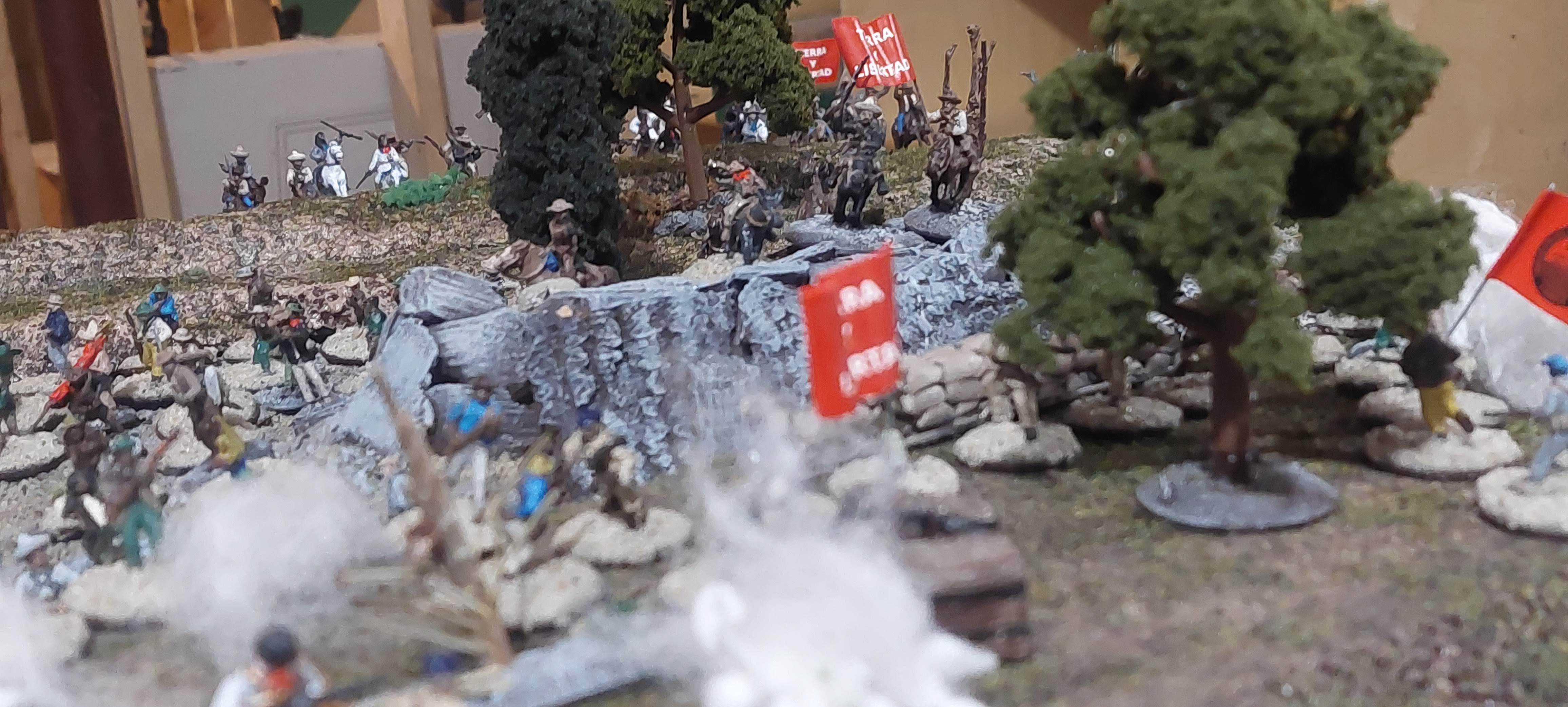
Berthold shouted orders back to Guerrero's group, who turned the westward toward the bay.

The horseman rode past the seven soldiers, now prisoners, being escorted off the table to the north by a guard of armed rebels.

Now at the top of the hill and in control of objective A, Berthold passed orders to the different PLM groups at his disposal. Group 4, the IWW contingent led by the daring Mosby, advanced up the left flank. They took up positions on a crescent-shaped hill on the eastern edge of the table.

Group 3 prepared to defend Positon A, while some of its number escorted the prisoners away. Group 2 advanced to the west. Two squads moved into the northern portion of the town, where they occupied the first three houses, while another headed for the hill further west on the bay.

On the southern hill, the fight between the government forces and the charging rebels continued.

Caule and the bulk of his column hurried up to the summit, where their vanguard had just captured Objective C.

The Rurales in the third-floor windows, however, caught the advanced group of Caule's force in the open on the wrong side of the barricades, and gunned down three of them. The other rebels fired on the approaching militia.

Three rebel rifles fired on the pro-government militia, killing two of them. Then, the surviving dynamiter of Caule's group lobbed a stick at the militia. It fell just short of his intended target.

The blast killed four of the militia, and pinned the lone survivor.

Back in the North, Vega sent scouts to investigate the explosions at Objective A. They ran into Pacheco's advanced squads. The rebels gunnwd them down. While he could not see his enemy, Colonel Vega observed his scouts falling, and realized the dangerous situation he now faced.

To the east, Mosby's column of wobblies exchanged shots with three soldiers in the windows and door of the white house on the corner. Neither marked any casualties.

Round Seven began with Caule's column, alone in the south, taking cover from the Rurales firing from the upper floor of the white house. The bulk of the group crouched behind the log barricades at Objective C.

Cuale himself and his staff hugged the edge of the hill and worked their way toward the white house.

In the North, the groups under Berthold's direct command improved their positions, covering windows in the northern houses, fortifying their hilltop positions, and resting after the previous round's charge in anticipation of a push further into Ensenada.
In the town square Vega, feeling exposed, ordered a runner to recall the reserve group of Federal soldiers.

He ordered members of his staff to take up defensive positions facing the rebels coming from the North.

The runner raced past the town's restaurant on the way to the reserve group.

He was able to intercept the soldiers before they marched to the front line.

The soldiers turned the corner and hurried back to headquarters. Up ahead, they could hear the first shots ring out around the plaza.

Rebels in the white house with the black roof killed one of Vega's staff officers and forced his partner to feel back to the plaza.

Vega managed to rally the frightened officer and sent him back into position.

Vega himself got out of the open, relocating to the south wing of the government building just as the reserve company returned to the area. Just ahead of the reserves, a runner from the Rurales carried a message informing Vega that the rebels controlled the southern hill. Vega ordered the signal to the gunship to adjust their target.

The government militia won a morale roll allowing them to charge back up the north slope of the south hill, threatening to retake Position C.

Behind them, the Rurales built a barricade across the western road, covering the southern approach into town.

Round 8 began with the Federal reserve committee charging toward the oncoming rebels. Vega ordered them to occupy the tavern and hold the plaza.

As they charged toward the tavern entrance however, PLM riflemen on overwatch in the white building and on the hill behind opened fire, killing three.

The soldiers returned fire but the rebels were safe in their buildings and in the trenches dug into the hilltop.

Vega sent the Rurale's messenger back to his unit with new orders. The Rurales were to hold their positions, but if their lines broke, their fallback position was to be the restaurant near the center of town. If they were forced to abandon the southern section of town, the Rurales were to put the buildings to the torch and leave no supplies or cover for the rebels.
At the top of the southern hill, Caule's comrades held out against intensifying fire from militia to their left and Rurales in the building to the north. The group's lone surviving dynamiter light his fuse. But the explosive went off in his hand!

The results were devastating, with six rebels killed, five pinned, and the log barricade in front of them destroyed. Caule's group, who had been the decoy and never intended to actually capture Position C, were alone, exposed, and at risk of being obliterated.

But to their north, Mosby's fearless wobblies continued to work their way south, exchanging shots with defenders in the buildings while half of the group charged across open ground. Two rebels fell under the overwatch fire from the white house. Two other rounds fired from the green house were near misses.

The wobblies cut the western road. Mosby ordered his three dynamiters to target the white house. They lit their fuses.

Another premature blast killed one of the dynamiters and pinned his rifleman partner.

Another dynamiter failed to get the fuse to light at all. But the third got the fuse engaged and threw the projectile with perfect accuracy. The dynamite detonated on the roof of the white house. The blast caused limited damage, though it did ignite a fire on the rooftop.

Next, the gunboat fired off its weapons. Six shells crashed into the southern hill, falling around the beleaguered PLM Group 1.

The barrage killed two more of the anarchists at Position C, and pinned the survivors. The pro-government militia saw their chance and charged up onto the hilltop, with their wealthy commanders riding alongside them. The six remaining rebels were surrounded and captured. The militia commander sent a rider back toward the plaza to inform Vega of their success and to call off the gunboat.

Caule and the five other men left in his party abandoned their plan to storm the white house, and climbed up the hill to fire at the militia before they could arrest their comrades.

Far to the North, Berthold sent a rider up a north-western hill to see if he could get a clear view of the plaza.

The rider, confirming the line of sight into town, signaled for the headquarters section to join him at the position.

With that, Round 8 came to a close and I finished playing for the day. A showdown between Caule and his best squad and the entire pro-government militia for the south hill would have to play out another day.

Would Mosby's unionist be able to reach Caule and relieve the isolated group?

Berthold had yet to deploy his best unit, the anarchist cavalry section led by Emilio Guerrero. Would they be able to storm Ensenada and capture the sate's capitol for the Liberal revolution?

From the northern ridge, Berthold could see the Federal soldiers trying to hold the plaza. This battle would continue a few days later... Check back for the conclusion.