Showing posts with label delicia. Show all posts

Monday, September 18, 2023

Delicia - finished

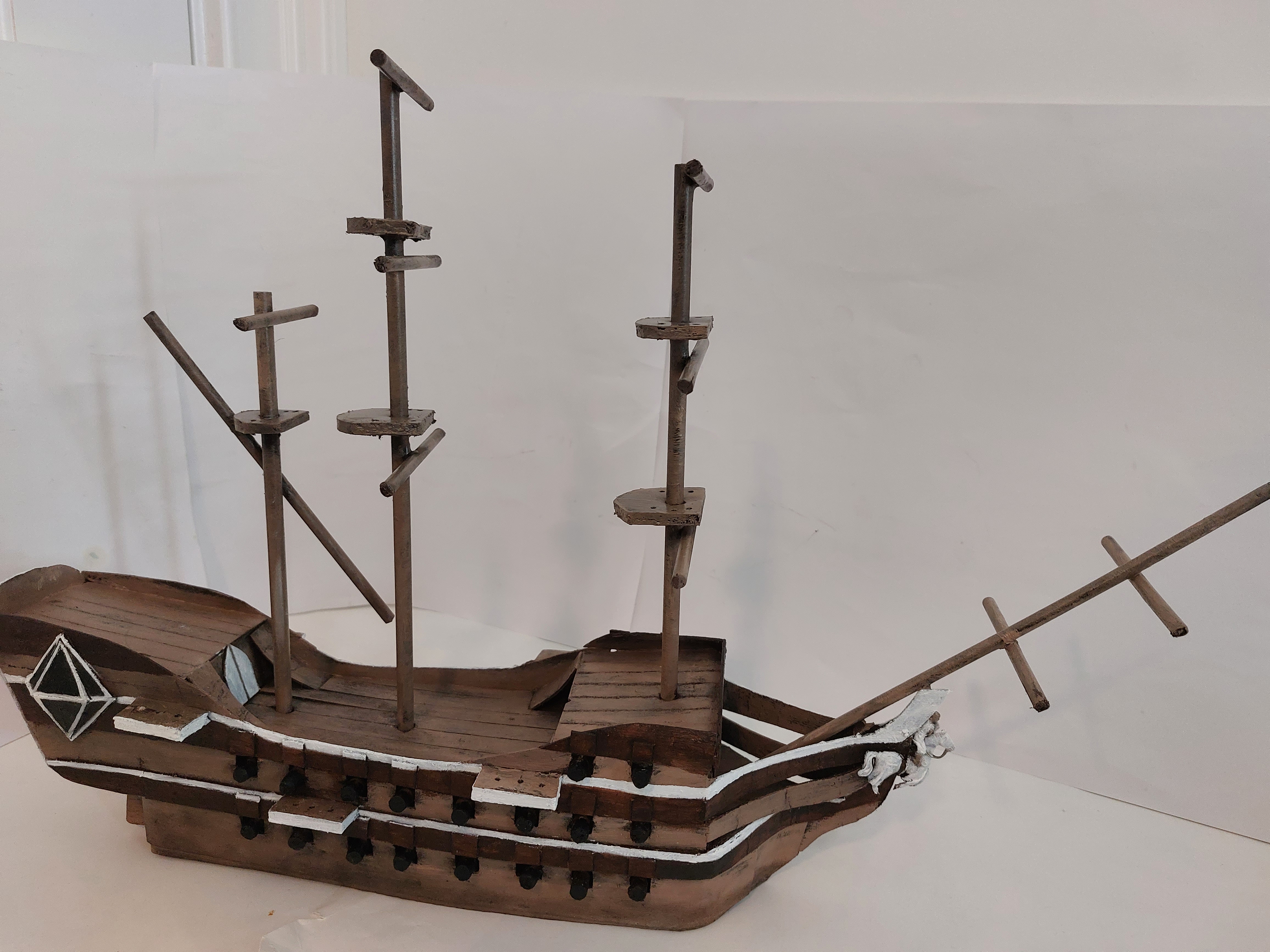
I recently finished the last touches on Woodes Rogers' Delicia. I previously posted a tutorial on the early steps of this project. Just like my last post, where I detailed at the bottom my process for painting, sails, and rigging, I failed to take photos of painting, rigging, and most of the work on the sails. 

Thus, here are some photos of the final steps of hanging the sails, followed by a lot of photos of the finished model.


Wednesday, May 31, 2023

Woodes Rogers' Ship Delicia

Captain Woodes Rogers, (yes, Woodes was his first name!) was from a wealthy shipping family from Bristol, England. He was a seaman from an early age, a slave trader, and a privateer against the Spanish who circumnavigated the earth while retaining both of his ships, the Duke and the Duchess, but losing his brother. Returning to England, Rogers lost a lawsuit brought by his crew over nonpayment of wages that drove him into bankruptcy, but in publishing his account, A Cruising Voyage Around the World, was able to regain some of his wealth and prestige. 

Along the trip, Rogers had rescued a marooned man named Alexander Selkirk, a Scottish sailor of the Royal Navy, from Juan Fernández Island in 1709. Selkirk, who survived alone for four years, served as Daniel Defoe's inspiration for his famous character Robinson Crusoe. 

In 1713, Woodes Rogers set of on a slaving expedition to Madagascar, though his real motive was to locate the legendary pirate colonies on the island and force them to surrender. For this voyage, Rogers, with the help of his financiers, purchased the Delicia, a 460 ton merchant vessel outfitted for war with 36-guns. 

Rogers located the pirate colonies, and you can read a great account of his efforts to convince them to return to England and give up their way of life in Colin Woodard's book, The Republic of Pirates: Being the True and Surprising Story of the Caribbean Pirates and the Man who Brought them Down. Eventually, Rogers convinced some of them to sign a petition asking the queen for clemency, and he returned to England in 1715, where he reaped in the profits of his slave trading. 

The British East India Company rejected Rogers' proposal of returning to Madagascar to turn the pirate haven into a British Colony. Instead, Rogers refit his plan to target the pirate den of Nassau in the Bahamas.

Rogers was able the convince King George I to issue "The King's Pardon" in September of 1717, which stated that any and all pirates who surrendered unconditionally before September 1718 would be welcomed back into the British realm, with their past crimes forgiven. 

Woodes Rogers assembled a fleet of seven ships, three of the Royal Navy, with 100 soldiers and 130 colonists. His flagship was the Delicia. With stacks of pardons in hand, as well as religious pamphlets to reform the pirates into colonists, Woods Rogers set sail for Nassau in April of 1718.

The British fleet arrived in Nassau on July 24, blocking the harbor and trapping a number of pirate vessels inside. A scant few resisted, such as Charles Vane, who busted through the blockade behind a fire ship. Most of the other residents--around two hundred pirates and as many refugees from other colonies--accepted the pardon. While the British fleet was formidable, the pieces of paper on which the pardons were written turned out to be the most powerful weapon in Rogers' arsenal, and he enacted the strategy of divide and conquer. The lack of unity among the pirates, exasperated by the existence of the pardon, ruined their ability to resist. Woodes Rogers became Royal Governor of the Bahamas until 1721, and served in that position again from 1728 until his death in 1732.

In building for a future Pirates game or campaign, I've built Woodes Rogers' ship, Delicia, as he makes the perfect opponent for my pirates.

Using roughly the same process I followed to build Bellamy's early ships, the Marianne and Sultana I contstructed the Delicia from cardboard and wooden dowels.


Adding the cannons to this ship was particularly difficult, as there are quite a few and I needed to balance each one as the glue dried.


Having very little to go on for this design, besides the weight of the ship and how many guns it held, I had to be creative. For the figurehead, I used a templar crusader, which seemed a fitting image for Rogers' anti-pirate expeditions.


After completing the general construction, I spray-primed the ship dark brown.


Next, I set about painting the ship in oil paints.


When the paint dries, I will add the sails and the rigging, and then the final paint touches: silver for the knight's armor on the figurehead, as well as for the name of the ship on the stern.

In the mean time, I will finally begin building the ships I set out to learn the skills to build some twenty or so vessels ago -- the Whydah Galley, in 2 versions. Wish me luck and check back later for updates!

Tuesday, May 23, 2023

Scratchbuilding the sloop Marianne and the Sultana Galley (Tutorial)

Folks seem interested in these cheap, easy, and fun cardboard ships I've been making. So for the next round I attempted to make a tutorial. Be forewarned, halfway through I got bored of taking photos and missed a few steps.

Here is the process I used to build a small sloop which I imagine as Sam Bellamy's Marianne. Below that, I'll add a short description of steps I took to build a slightly larger, 3-masted ship which I imagine as the Sultana, another of Bellamy's.

The tools I used:
Small awl
Scissors
Pliers (mine are part of my leatherman knife)
Utility or craft knife.

Supplies and material:
Oil paint (water-based paint will lead to the cardboard dissolving over time!)
Elmer's Glue-all.
I used wooden dowels of a few various sizes for the masts and, on larger ships than the Marianne, the cannons.
I used wooden bbq skewers, thinner than the dowels, for some of the yards.

I used two types of cardboard:
Typical, thick corrugated cardboard that you find in box boxes.
Thin, smooth cardboard that comes inside wine boxes, making the grid the bottles sit within. If you look closely, one side of this cardboard is rough, but the other runs in parallel lines, making it a great choice for the hull and deck planks. Don't drink wine? Do what I did. Go buy a couple bottles of rum from your local liquor store and ask for a wine box to cary them out in.


The Marianne

The Marianne was the first ship  SamBellamy captained, the commission handed to him by Benjamin Hornigold. Bellamy had impressed Hornigold by outsmarting the latter's rival, Privateer Henry Jennings. In taking the promotion to captain, Bellamy passed over Edward Thatch, the future Blackbeard, and many other crewmen who had sailed much longer under Hornigold. Though Bellamy would soon take over command of Hornigold's fleet -- after a vote of the crew, who preferred Bellamy's war on all of the crowned heads of Europe over Hornigold's refusal to attack English ships -- Bellamy ultimately proved Hornigold's original opinion of him was correct by becoming the most successful pirate in history during his short career. At 27, Bellamy sailed off with 170 of Hornigold's men in the Marianna and the Postillon. 

Originally a French ship, the Marianne was a small sloop painted lead white at the waterline. The stern was painted blue, with trim of yellow and blue on the quarterdeck.  Under Bellamy, she was a well-armed sloop, with 8 to 10 guns and also well-used. Surviving reports describe the peeling paint and major battle damage. Unfortunately, that is all I've been able to learn about the sloop.

I began by drawing out the bottom of a water-lined hull, and then a second, slightly larger shape for the deck. Don't forget to put a hole in the center of your deck for the mast. If you attempt to do this later, after you've started putting the ship together, it may get damaged by your force.

I used a couple small pieces of cardboard as risers to hold the deck above the base, using the deck and base to measure the width of the risers. Then I added two more risers for the quarterdeck.


I glued two dowels together for the mast and boom. Note that the hole for the mast is slightly forward from center.


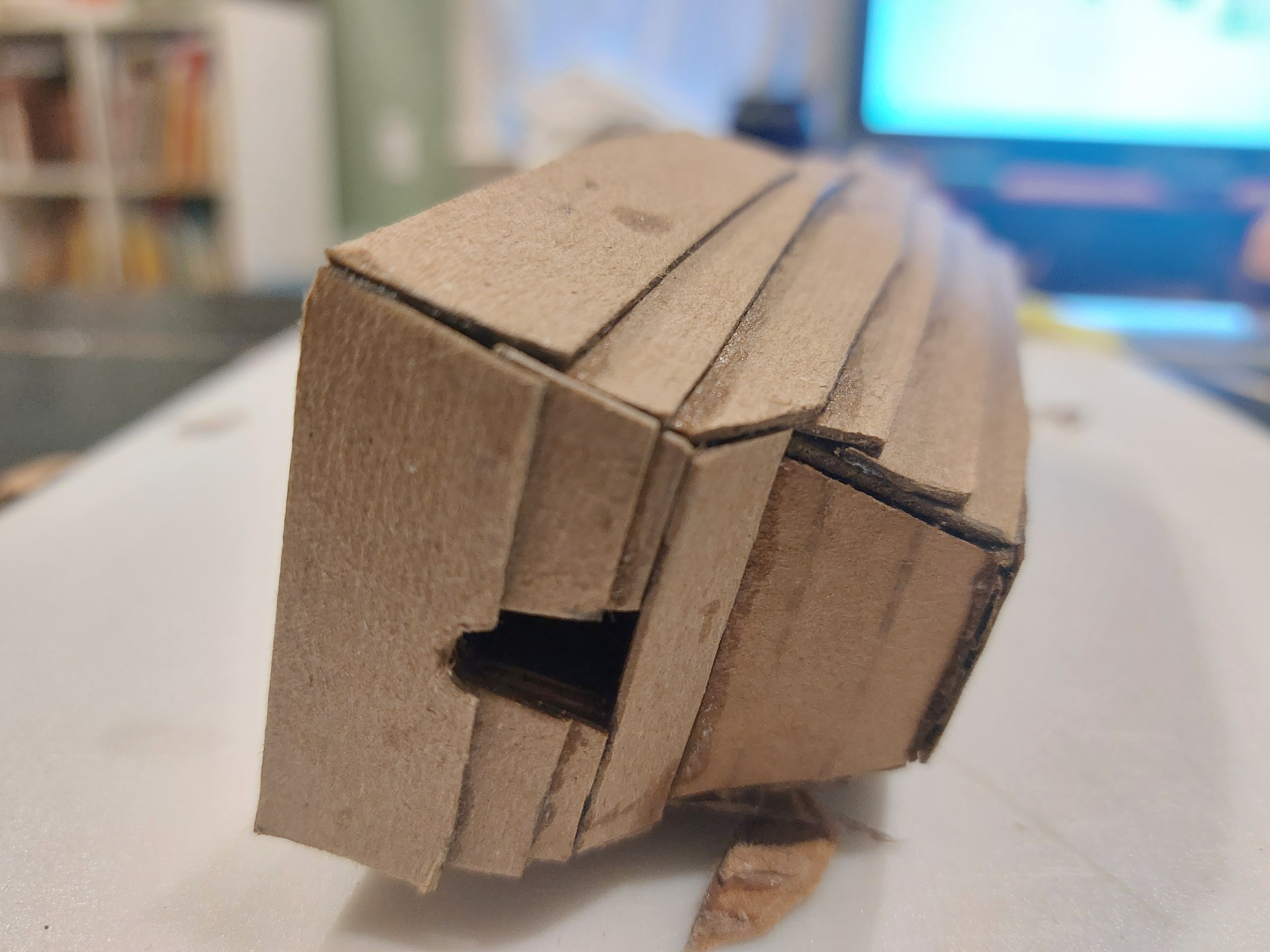
Next, I carefully, slowly, glued sheets of wine-box insert cardboard to the hull of the ship. If you can't hold these together with a vice or some improvised weights, use your hands. Glue-all dries pretty fast, but this is still one of the most difficult parts. I usually do this while listening to an audio book or, more realistically, watching TV.


Not shown here, but I glued the rest of the yards on to the mast while it was still detached from the hull. I also cut a window into the stern section of the riser before I glued it on.


Next, I wrapped the quarterdeck the same way that I had wrapped the hull. 


I added a simple door to the quarterdeck.


Next, I cut planks out of the wine-box insert cardboard. I laid these down over the deck horizontally. After looking closer at other model ships, I probably was supposed to do this vertically instead.


I followed a similar process with the sides of the ship.


As well as the stern.


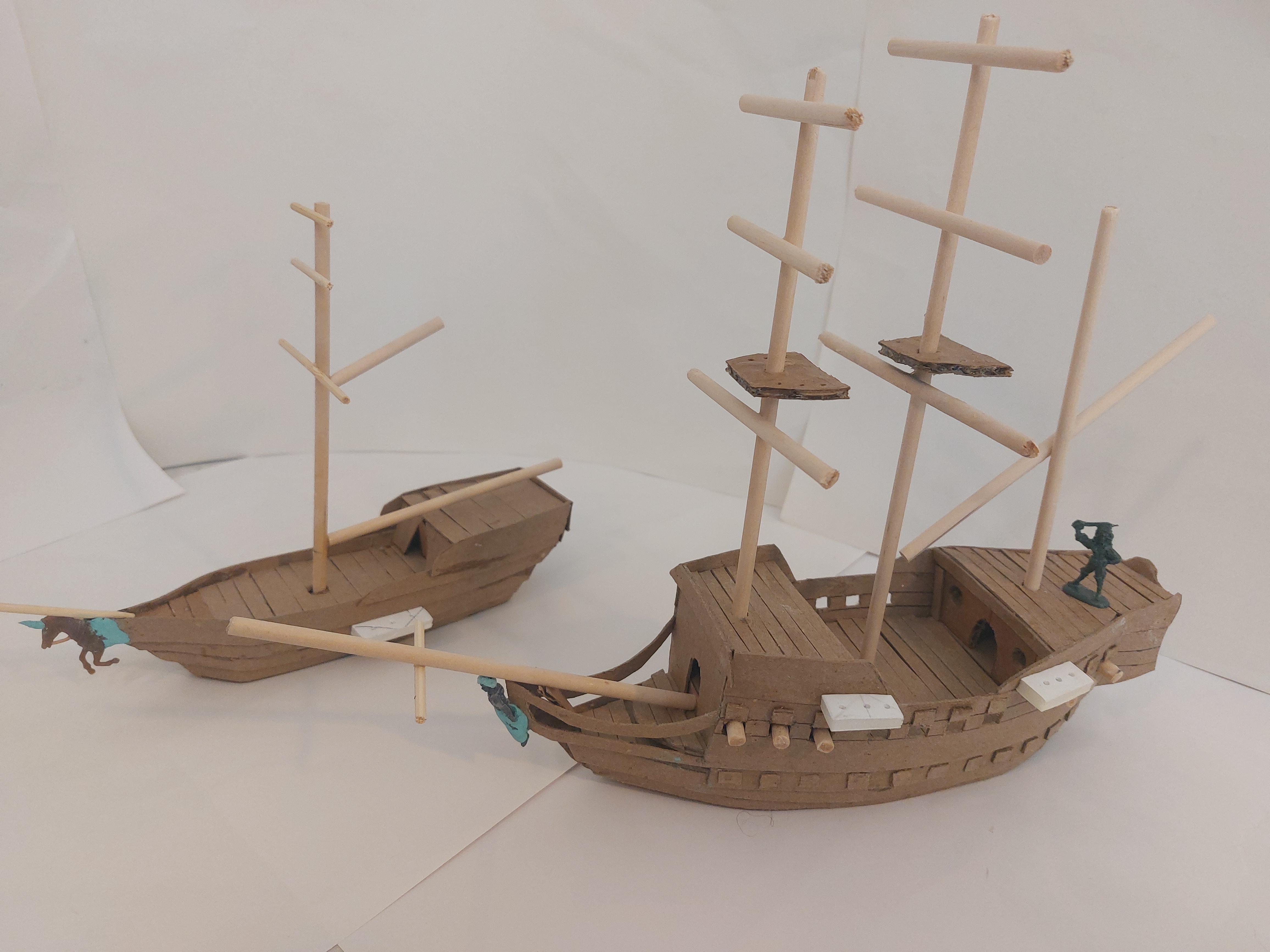
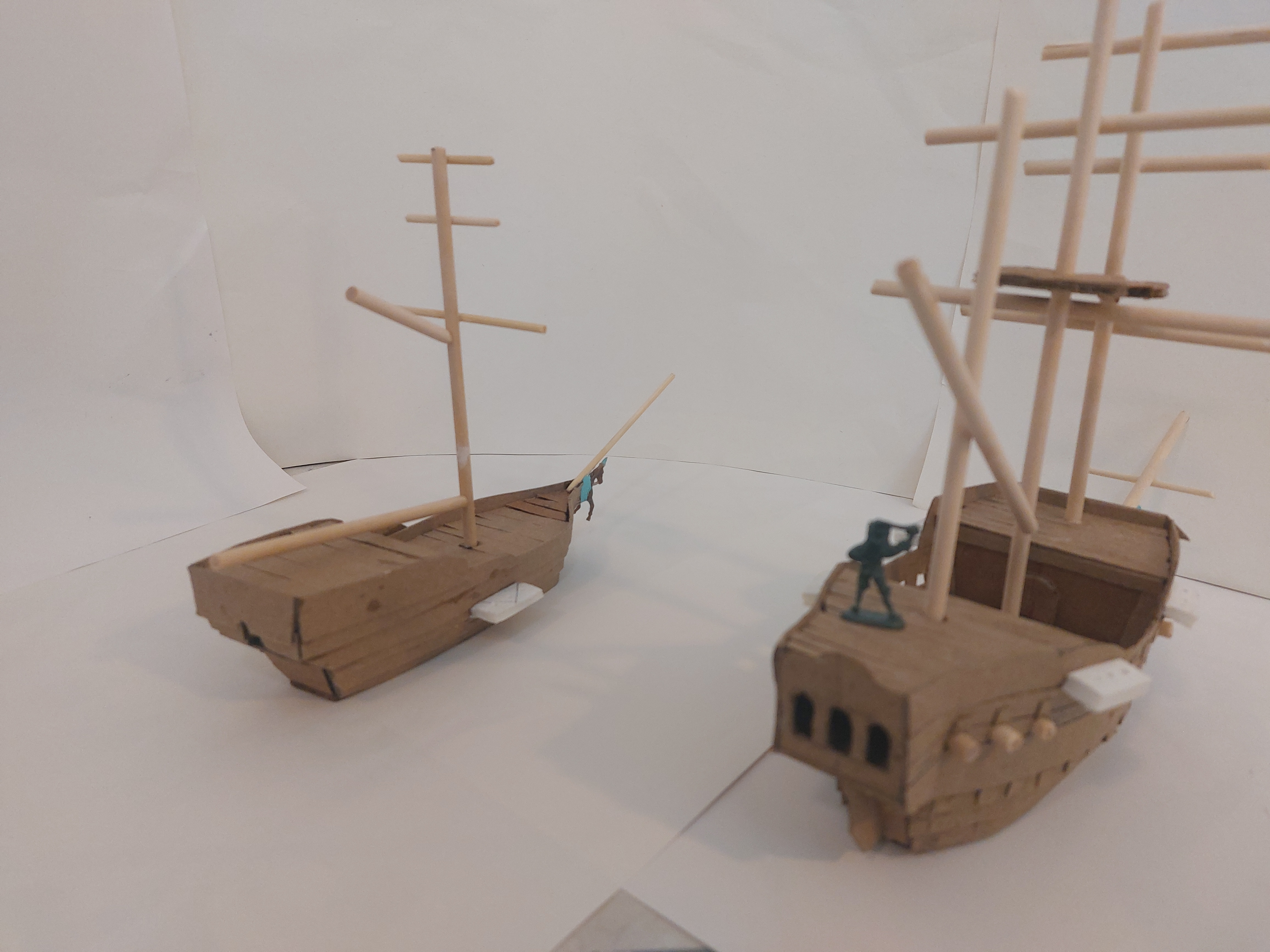
Next, I glued the mast in place. I used rectangles of foam board, with three holes punched through it with the awl, to hold the base of the rat lines. I made a simple figurehead out of a spare miniature horse and a little bit of Miliputty. This one is a unicorn, which were common figureheads. I placed a little 1/72 pirate on the deck for scale. Now the Marianne is ready to be primed and painted.


The Sultana


After completing these early steps on the Marianne, I began  second, slightly-larger, three-masted ship, which I imagine to be the Sultana. 

The Sultana was a three-masted galley described in some sources as a miniature version of the Whydah Galley. In the time between Christmas of 1716 and New Years Day of 1717, the crew careened The Sultana at La Blanquia Island off the coast of Venezuela, where they "made" the ship into "a man-of-war." I'm still not totally sure what that means in this case other than adding more cannon.

Now, I didn't photograph the early steps, but they were pretty similar to the steps I took to start out the hull of the Marianne, except this hull was slightly larger, there are extra decks, and there are 3 holes for the 3 masts instead of the 1 on the sloop.


As you can see in the photo below, I've also cut out doors and windows for the castles holding up the upper decks.


The quarter deck sits upon an extra base piece I cut, so that it may hang farther over the back of the stern.


When I cut my strips for the sides of the hull, I made 20 square holes for the cannon. Then I cut a dowels into 12 small sections for the cannons. I glued them into the holes I had made, very carefully and slowly. It was pretty annoying to balance them in place while they dried, and required a lot of patience. I kept losing them inside the ship. When they dried, I added extra glue, to help prevent the inevitable breaking. If you are less cheap than me, and your measurements are true, you could instead cut the dowels into sections slightly longer than the width of your hull, so that one dowel becomes 2 cannons (sticking out parallel holes on both sides of the hull). This would eliminate the balancing-while gluing issue.
I added railings to the deck at the bow.


I glued on a row of port hole covers just above the waterline for the massive oars they would have used in shallow waters, galley's being unique for their ability to be powered by oars, each requiring a team.


For the figurehead, I converted a figure to attempt to recreate the "sultana" depicted in the figurehead of a later English ship by the same name. 


Finally, I spray painted both ships with my favorite dark brown primer.


Check back next time, as I paint and rig these pirate ships!